🌟 Self Centered Synonyms: 50+ Words to Describe Selfish Behavior
Finding the right words to describe a self-centered person can make your writing clearer and more accurate. Whether you are writing an essay, describing a character, improving your vocabulary, or trying to explain someone’s behavior, choosing the right synonym helps you express your meaning without using the same word repeatedly.
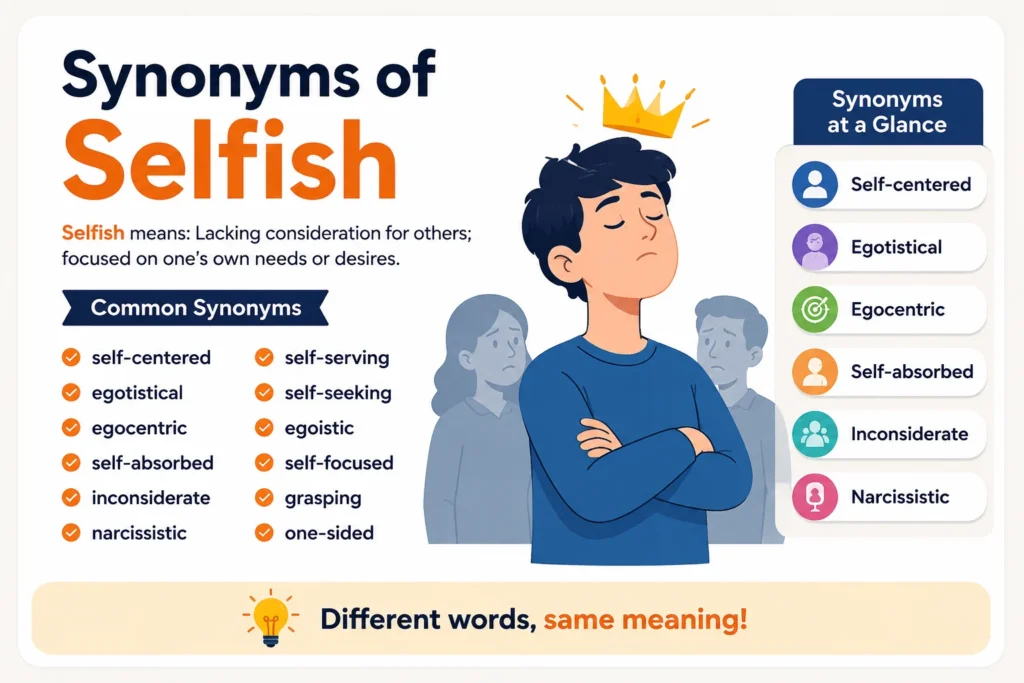
The best self-centered synonyms include self-absorbed, egocentric, selfish, self-focused, self-involved, self-serving, and self-important. Although these words are related, they do not all mean exactly the same thing. Some describe a person who thinks mostly about themselves, while others suggest that someone puts personal benefits ahead of other people’s needs.
For example, a self-absorbed person may spend most of a conversation talking about their own experiences. A self-serving person may make decisions mainly to gain a personal advantage. An egocentric person may struggle to understand how a situation looks from another person’s point of view.
Understanding these differences helps you choose words that fit the situation. It also prevents you from using a strong label when a more neutral description would be more accurate.
This guide explains self-centered synonyms, their meanings, example sentences, related vocabulary, antonyms, and differences between terms such as selfish, narcissistic, self-reliant, and self-assured.
📚 What Does Self Centered Mean?
Self-centered means being mainly concerned with yourself, your own needs, your feelings, or your interests, sometimes without giving enough attention to other people.
A self-centered person may focus heavily on personal goals, expect others to pay attention to them, or have difficulty considering how their actions affect someone else.
For example:
“Mark can be self-centered because he often changes the plans to suit himself without asking what his friends want.”
In this sentence, the word describes behavior that places one person’s preferences above the group’s needs.
Being self-centered does not necessarily mean someone is always unkind. A person may behave selfishly in one situation but show care and consideration in another. It is usually more helpful to describe a specific action than to assume that one behavior explains a person’s entire character.
Self-Centered Definition in Simple English
Self-centered means thinking mostly about yourself and paying too little attention to other people.
Also read:Synonyms of King: 50+ Words, Meanings, and Examples 👑📚
The word is often used when someone:
- Talks mainly about their own life.
- Expects other people to meet their needs.
- Ignores other people’s opinions or feelings.
- Makes decisions without considering how others may be affected.
- Wants attention or praise more than cooperation.
These behaviors can appear in friendships, families, workplaces, and social settings. However, context matters. Taking time to care for yourself or protect your personal boundaries is not automatically self-centered.
✨ Best Self-Centered Synonyms
The best synonym depends on the behavior you want to describe. Some alternatives are mild and descriptive, while others carry a stronger negative meaning.
| Synonym | Meaning | Example |
| Self-absorbed | Deeply focused on one’s own thoughts or feelings | He seemed self-absorbed during the conversation. |
| Egocentric | Seeing situations mainly from one’s own point of view | Her egocentric attitude made teamwork difficult. |
| Selfish | Putting personal needs ahead of others | It was selfish to take all the food without asking. |
| Self-involved | Very concerned with one’s own life and problems | He was too self-involved to notice her disappointment. |
| Self-focused | Concentrating mainly on oneself | She became self-focused while working toward her goal. |
| Self-serving | Acting mainly for personal benefit | The proposal seemed self-serving. |
| Self-important | Believing oneself to be more important than others | His self-important manner annoyed the team. |
| Egocentric-minded | Strongly focused on one’s own perspective | His egocentric-minded approach limited discussion. |
| Narcissistic | Showing excessive self-focus or a strong need for admiration | The character displayed narcissistic behavior. |
| Inconsiderate | Not thinking enough about other people’s needs | It was inconsiderate to interrupt everyone. |
| Egotistical | Having an exaggerated sense of one’s own importance | His egotistical comments upset his colleagues. |
| Self-obsessed | Extremely focused on oneself | She seemed self-obsessed in every discussion. |
| Self-interested | Motivated by personal interests | The decision was based on self-interested goals. |
| Conceited | Having an overly high opinion of oneself | He sounded conceited when discussing his success. |
| Self-indulgent | Allowing oneself too much pleasure or comfort | His self-indulgent habits affected his budget. |
These terms overlap, but they are not perfect replacements for one another. For instance, “inconsiderate” describes a lack of thought for others, while “conceited” focuses more on an overly high opinion of oneself.
💡 Self-Centered Synonym: Which Word Should You Choose?
When you need a synonym for self-centered, think about the main behavior involved.
If someone focuses on their own feelings, “self-absorbed” may fit. If they regularly put their own interests first, “selfish” may be more direct. If they act to gain a personal advantage, “self-serving” is often more precise.
Here are a few examples.
Original: “He is self-centered and rarely asks about other people.”
Alternative: “He is self-absorbed and rarely asks about other people.”
Original: “Her self-centered decision hurt the group.”
Alternative: “Her selfish decision hurt the group.”
Original: “The manager made a self-centered choice to gain more recognition.”
Alternative: “The manager made a self-serving choice to gain more recognition.”
Each alternative highlights a slightly different part of the behavior.
Another Word for Self-Centered in Everyday English
For simple, everyday writing, these are useful choices:
- Selfish
- Self-absorbed
- Self-focused
- Inconsiderate
- Egocentric
- Self-involved
- Self-important
- Thoughtless
“Selfish” is often the easiest word to understand. “Self-absorbed” is useful when someone seems preoccupied with personal matters. “Thoughtless” is milder and may describe an action that was careless rather than intentionally selfish.
Other Words for Self-Centered in Formal Writing
In essays, reports, and professional writing, consider terms that describe the specific behavior rather than making a broad judgment.
Useful options include:
- Egocentric
- Self-interested
- Self-serving
- Self-focused
- Inconsiderate
- Excessively self-focused
- Lacking consideration for others
For example, instead of writing, “The supervisor is self-centered,” you could write, “The supervisor often makes decisions without considering the team’s concerns.”
The second version gives readers a clearer explanation of the behavior.
🧠 Self-Absorbed Synonyms
Self-absorbed describes someone who is so focused on their own thoughts, feelings, problems, or interests that they may overlook what is happening around them.
Common self-absorbed synonyms include:
- Self-involved
- Self-obsessed
- Egocentric
- Self-focused
- Preoccupied with oneself
- Introspective, in some contexts
- Inward-looking
- Self-centered
However, these words do not have identical meanings. Being introspective means examining your own thoughts and feelings. That can be useful and healthy. It does not automatically mean you ignore other people.
Examples of Self-Absorbed in Sentences
“She was so self-absorbed that she did not notice her friend needed help.”
“He became self-involved while worrying about his own problems.”
“The character’s self-obsessed behavior created tension with the other characters.”
“Instead of listening to the group, he remained focused on his own concerns.”
A self-absorbed person may not intend to hurt anyone. The term describes where their attention tends to go, not necessarily why they behave that way.
🙋 Selfish Synonyms and Their Meanings
Selfish means putting your own interests, comfort, or benefits ahead of other people’s needs, especially when fairness or consideration is expected.
Common synonyms for selfish include:
- Self-centered
- Self-serving
- Egocentric
- Greedy
- Inconsiderate
- Thoughtless
- Self-interested
- Uncooperative
- Ungenerous
- Self-indulgent
The best choice depends on the behavior.
“Greedy” suggests wanting more money, possessions, food, or other benefits than is reasonable. “Ungenerous” describes an unwillingness to give or share. “Uncooperative” focuses on refusing to work with others.
Another Word for a Selfish Person
If you need another word for a selfish person, consider “selfish individual,” “self-centered person,” “self-serving person,” or “inconsiderate person.”
For a more specific description, you could say:
- Someone who puts personal gain first
- Someone who rarely considers other people’s needs
- Someone who is unwilling to share
- Someone who expects others to make sacrifices for them
- Someone who prioritizes personal comfort over fairness
These descriptions explain what the person does rather than relying only on a label.
Synonym for Selfishness
Selfishness is the quality or behavior of putting one’s own interests ahead of others.
Related terms include:
- Self-centeredness
- Self-interest
- Self-serving behavior
- Egoism
- Greed, when excessive desire for more is involved
- Inconsideration
- Lack of generosity
Not every form of self-interest is selfishness. Making decisions that protect your health, time, safety, or financial needs can be reasonable. The word “selfishness” usually suggests that a person’s interests are being placed ahead of others in an unfair or inconsiderate way.
🎭 Egoist Synonyms and Egoistic Meaning
An egoist is a person who places strong importance on personal interests or benefits. The word is often associated with the belief that one’s own interests should take priority.
Common egoist synonyms include:
- Self-interested person
- Self-centered person
- Egocentric person
- Self-serving individual
- Self-focused individual
- Selfish person
“Egoistic” is an adjective related to egoism. It describes behavior or attitudes that focus strongly on personal interests.
For example:
“His egoistic approach made it difficult to reach a fair agreement.”
The word “egoist” may also appear in philosophical discussions about egoism, which explores the role of self-interest in human behavior and moral decision-making. In that context, it can have a more specific meaning than simply calling someone selfish.
Egoistic vs. Egocentric
“Egoistic” usually emphasizes personal interest or benefit. “Egocentric” emphasizes viewing the world mainly through one’s own perspective.
For example:
- Egoistic: She chose the option that gave her the greatest personal advantage.
- Egocentric: He assumed everyone would enjoy the activity he preferred.
The two words overlap, but the difference can help you express your meaning more clearly.
💼 Self-Serving Synonyms
Self-serving describes an action, statement, or decision that mainly benefits the person making it.
Common synonyms for self-serving include:
- Self-interested
- Self-benefiting
- Opportunistic
- Egotistical, in some contexts
- Self-promoting
- Personally advantageous
- Motivated by personal gain
- Serving one’s own interests
For example:
“The manager’s self-serving proposal gave him credit while leaving the difficult work to others.”
The term often carries a negative meaning because it suggests that personal benefit is being placed above fairness or the needs of a group.
Self-Serving vs. Selfish
“Selfish” often describes a person’s behavior toward other people. “Self-serving” often emphasizes the benefit a person receives from a particular action, decision, or argument.
For example:
- Selfish: He refused to share the supplies with his teammates.
- Self-serving: He supported the new policy because it would increase his own influence.
Both words suggest personal priorities, but “self-serving” often highlights motivation.
Synonym for Self-Serving in Professional Writing
In business or academic writing, you may want a more neutral phrase.
Consider:
- Driven by personal interests
- Designed to benefit the individual
- Focused on personal advantage
- Motivated by individual gain
- Primarily beneficial to the decision-maker
These phrases may sound more objective than calling a person selfish. They are especially useful when describing workplace decisions or public statements.
👑 Self-Importance Synonyms
Self-importance means having an exaggerated belief that you are especially important or deserve more attention or respect than others.
Common self-importance synonyms include:
- Conceit
- Egotism
- Arrogance
- Vanity
- Pride, when excessive
- Grandiosity
- Self-regard, depending on context
- Inflated sense of importance
For example:
“His sense of self-importance made him expect special treatment.”
Another Word for Self-Important
A person who seems excessively self-important may be described as:
- Conceited
- Egotistical
- Arrogant
- Pretentious
- Vain
- Overbearing
- Pompous
- Full of themselves
These words differ in tone. “Pretentious” suggests trying to appear more impressive or important than one really is. “Pompous” often describes someone who behaves in a grand or overly formal way to show importance.
“Self-important” is often a useful general choice because it directly describes the attitude without implying a medical condition.
Self-Aggrandizement Synonyms
Self-aggrandizement means making yourself appear more powerful, successful, or important than you are.
Related terms include:
- Self-promotion
- Self-glorification
- Egotism
- Grandstanding
- Boastfulness
- Self-enhancement
- Exaggeration of one’s achievements
For example:
“The speech sounded like self-aggrandizement because it focused on the speaker’s achievements rather than the team’s work.”
Self-promotion is not always negative. People may need to describe their skills when applying for a job or presenting their work. The word “self-aggrandizement” usually suggests excessive or misleading efforts to increase one’s status.
🪞 Synonyms for Self-Involved and Self-Obsessed
“Self-involved” and “self-obsessed” describe strong attention to one’s own life, thoughts, feelings, or appearance.
Also read:Synonyms for Inside: 50+ Useful Words, Meanings, and Examples 🚪📚
Useful synonyms include:
- Self-absorbed
- Self-centered
- Self-focused
- Egocentric
- Preoccupied with oneself
- Self-concerned
- Self-obsessed
- Self-involved
Self-Involved Meaning
A self-involved person is very concerned with personal matters and may not give enough attention to other people.
Example:
“He was so self-involved that he kept talking about his promotion while his friend tried to explain a serious problem.”
Self-Obsessed Meaning
Self-obsessed is a stronger, more informal expression for being excessively focused on oneself.
Example:
“The fictional character became self-obsessed after receiving constant praise.”
The word can describe a pattern of behavior, but one example alone may not justify describing someone’s entire personality this way.
Self-Obsessed vs. Self-Confident
Self-obsession is not the same as self-confidence. A confident person can believe in their abilities while respecting other people. A self-obsessed person may focus excessively on their own needs or image.
Confidence becomes a problem only when it is paired with behavior that disregards others, overstates personal importance, or prevents useful feedback from being heard.
🧩 Synonyms for Narcissism and Narcissistic
Narcissism is a term used to describe excessive self-focus, a strong need for admiration, or an inflated sense of personal importance. In everyday conversation, people sometimes use “narcissistic” loosely to describe someone who seems selfish or attention-seeking.
Related words include:
- Egocentrism
- Egotism
- Vanity
- Conceit
- Self-absorption
- Grandiosity
- Self-importance
- Excessive self-focus
These are related concepts rather than exact synonyms in every context.
What Is Another Word for Narcissism?
Depending on the intended meaning, alternatives may include “egotism,” “vanity,” “self-absorption,” or “self-importance.”
For example:
“His constant need for praise showed vanity.”
“Her behavior seemed self-absorbed because she rarely considered other people’s concerns.”
The word you choose should reflect the specific behavior you want to describe.
Synonyms of Narcissistic
Possible alternatives include:
- Self-absorbed
- Egotistical
- Conceited
- Self-important
- Grandiose
- Vain
- Egocentric
However, these terms should not be treated as medical diagnoses. Narcissistic personality disorder is a mental health diagnosis that requires an appropriate professional assessment. A person who acts selfishly or seeks attention in one situation does not automatically have this disorder.
When writing about real people, describing specific actions is often fairer and more accurate than assigning a psychological label.
🧭 Self-Interested Synonyms
Self-interested means motivated by personal needs, goals, or benefits.
Possible synonyms include:
- Self-serving
- Self-focused
- Personally motivated
- Driven by personal gain
- Self-benefiting
- Egoistic
- Self-concerned
Self-interest is not always negative. A person may choose a job that pays enough to support their family, set boundaries to protect their time, or save money for future needs.
These actions can be reasonable even when they benefit the individual.
The word becomes more negative when a person ignores fairness, breaks promises, or harms others to gain an advantage.
Self-Interest vs. Selfishness
Self-interest means considering what benefits you. Selfishness usually suggests placing your interests ahead of other people’s needs in an unfair or inconsiderate way.
For example:
- Self-interest: She compared salaries before choosing a job.
- Selfishness: She took credit for her colleague’s work to get a promotion.
The first example describes a personal decision. The second describes behavior that unfairly disadvantages someone else.
🌱 Self-Reliant and Self-Reliance Synonyms
Self-reliant means able to manage tasks, make decisions, or solve problems independently. Self-reliance is the ability to depend on your own skills and judgment.
Synonyms for self-reliant include:
- Independent
- Self-sufficient
- Resourceful
- Autonomous
- Capable
- Independent-minded
- Self-supporting
Related terms for self-reliance include:
- Independence
- Autonomy
- Self-sufficiency
- Resourcefulness
- Personal responsibility
Is Self-Reliance the Same as Being Self-Centered?
No. Self-reliance and self-centeredness have different meanings.
A self-reliant person can handle responsibilities independently while still caring about other people. A self-centered person may focus mainly on personal needs and fail to consider others.
For example:
“Maria is self-reliant because she can manage her finances and solve problems independently.”
“Maria is self-centered if she repeatedly ignores other people’s needs when making shared decisions.”
Independence is not the same as selfishness. Healthy self-reliance can help people make responsible choices and maintain balanced relationships.
Synonyms of Self-Reliant in a Sentence
“Jordan is independent and can complete the project without constant help.”
“The resourceful student found a solution using the materials available.”
“An autonomous team can make many decisions without waiting for approval.”
These alternatives focus on ability and independence, not a lack of concern for other people.
💬 Self-Assured and Self-Confidence Synonyms
Self-assured means confident in your abilities, decisions, or judgment. It is generally a positive term.
Common self-assured synonyms include:
- Confident
- Secure
- Certain
- Composed
- Poised
- Assured
- Self-confident
- Comfortable with oneself
Related synonyms for self-confidence include:
- Confidence
- Assurance
- Self-belief
- Poise
- Certainty
- Trust in one’s abilities
Self-Assured vs. Self-Important
A self-assured person trusts their abilities. A self-important person believes they deserve unusual attention or status.
For example:
“She was self-assured during the presentation because she had prepared carefully.”
“He was self-important because he expected everyone to stop working whenever he entered the room.”
Confidence does not require putting other people down. A person can be confident and respectful at the same time.
Synonym for Self-Confidence
“Self-belief” is a useful alternative for self-confidence. “Assurance” and “poise” may also fit, depending on the sentence.
Example:
“Her self-confidence helped her speak clearly during the interview.”
Alternative:
“Her self-belief helped her speak clearly during the interview.”
Self-confidence is different from self-centeredness, so these words should not be used as direct replacements for one another.
❤️ Synonyms for Self-Worth, Self-Esteem, and Self-Image
Self-worth, self-esteem, and self-image all relate to how people view themselves, but they emphasize different ideas.
Self-Worth Synonyms
Self-worth refers to the sense that you have value as a person.
Also read:Synonyms for Companion: 100+ Words, Meanings, and Examples 🤝
Related terms include:
- Self-respect
- Personal worth
- Sense of value
- Self-esteem, in some contexts
- Dignity
- Self-acceptance
Self-Esteem Synonyms
Self-esteem refers to how a person evaluates or feels about themselves.
Common alternatives include:
- Self-confidence, in some contexts
- Self-respect
- Self-regard
- Self-acceptance
- Positive self-image
- Self-belief
These terms are related but not identical. A person may respect themselves while still feeling uncertain about a particular skill.
Self-Image Synonyms
Self-image means the way a person sees or understands themselves.
Possible alternatives include:
- Self-perception
- Self-concept
- Personal image
- Sense of identity
- View of oneself
For example:
“Her self-image improved as she recognized her strengths.”
Alternative:
“Her self-perception changed as she recognized her strengths.”
Are Self-Worth and Self-Centeredness the Same?
No. A healthy sense of self-worth does not mean believing that you are more important than everyone else.
People can value themselves while respecting other people’s needs. In fact, healthy boundaries and self-respect can support fairer relationships.
Self-centeredness involves giving excessive priority to one’s own perspective or interests. Self-worth is about recognizing personal value.
🌧️ Self-Pitying, Self-Blaming, and Self-Hating Synonyms
Some words that begin with “self” describe negative feelings directed inward rather than behavior that puts personal interests ahead of others.
They are related to self-centeredness only in certain contexts and should not be used as direct synonyms without considering their meanings.
Self-Pitying Synonyms
Self-pitying describes someone who focuses strongly on their own sadness, hardship, or sense of unfair treatment.
Possible alternatives include:
- Pity-seeking
- Self-sympathetic, in some contexts
- Dwelling on personal misfortune
- Focused on one’s own suffering
Example:
“After the setback, he became self-pitying and struggled to consider possible solutions.”
Self-pity is not the same as asking for help or expressing sadness. People can experience real difficulties and deserve support without being described as self-pitying.
Self-Blaming Synonyms
Self-blaming means holding yourself responsible for a problem or event, sometimes more than the facts support.
Related phrases include:
- Self-critical
- Self-accusing
- Blaming oneself
- Taking personal blame
- Self-reproachful
Example:
“She kept blaming herself for a decision that involved several people.”
Self-blame differs from accountability. Taking responsibility for a mistake can be constructive, while excessive self-blame may overlook circumstances outside a person’s control.
Self-Hating Synonyms
Self-hating describes strong dislike or hostility toward oneself. Related expressions include:
- Self-loathing
- Self-rejecting
- Deeply self-critical
- Negative toward oneself
These terms are emotionally strong and should be used carefully. They are not synonyms for self-centeredness, because they describe negative feelings about oneself rather than excessive self-prioritization.
⚠️ Self-Destructive and Self-Destruction Synonyms
Self-destructive describes behavior that harms a person’s own well-being, progress, or relationships.
Possible synonyms and related expressions include:
- Harmful to oneself
- Self-sabotaging
- Counterproductive
- Damaging to one’s own interests
- Destructive to personal progress
Self-destruction is the process or result of seriously damaging oneself or one’s own position. It can be used in a figurative sense, such as describing a pattern of choices that harms a person’s career.
Example:
“Repeatedly missing important deadlines became a self-sabotaging habit that damaged his professional reputation.”
Self-destructive behavior is not the same as selfishness. A person can harm their own interests without placing themselves above other people.
Self-Destructive vs. Self-Serving
Self-destructive behavior harms the person engaging in it. Self-serving behavior is mainly intended to benefit that person.
For example:
- Self-destructive: He ignored important responsibilities and lost an opportunity.
- Self-serving: He took credit for another person’s work to gain recognition.
Understanding the difference helps you select a more accurate word.
🧊 Synonyms for Lack of Empathy
Empathy is the ability to understand or relate to another person’s feelings or point of view. A lack of empathy may make it harder to respond with care or consideration.
Related descriptions include:
- Unempathetic
- Insensitive
- Inconsiderate
- Unresponsive to others’ feelings
- Emotionally detached, in some contexts
- Indifferent
- Unfeeling, in some contexts
These words differ in strength and meaning.
“Insensitive” often means failing to consider how words or actions may affect someone. “Indifferent” suggests a lack of interest or concern. “Emotionally detached” may describe distance from feelings without necessarily implying selfishness.
Self-Centered vs. Lacking Empathy
The terms are related but not identical.
A self-centered person focuses mainly on personal needs or viewpoints. A person who lacks empathy may have difficulty recognizing or responding to another person’s feelings.
For example:
“He was self-centered because he insisted that everyone follow his schedule.”
“She seemed insensitive when she dismissed her friend’s concerns.”
Both behaviors can affect relationships, but they describe different problems.
It is also important not to assume that a person lacks empathy simply because they do not show emotion in an expected way. People express feelings differently, and context matters.
🔄 Antonyms for Self-Centered
Antonyms are words with opposite or contrasting meanings. The best antonym for self-centered depends on whether you want to emphasize kindness, generosity, cooperation, or concern for other people.
Common antonyms for self-centered include:
- Selfless
- Altruistic
- Considerate
- Thoughtful
- Generous
- Compassionate
- Empathetic
- Unselfish
- Cooperative
- Other-focused
Selfless vs. Self-Centered
Selfless describes someone who considers other people’s needs and may put those needs ahead of personal convenience.
Example:
“She was selfless when she gave her time to help the new students.”
However, being selfless does not mean ignoring all personal needs. People can care for others while also maintaining boundaries and looking after their own well-being.
Unselfishness Synonym
Useful synonyms for unselfishness include:
- Generosity
- Altruism
- Selflessness
- Consideration
- Compassion
- Thoughtfulness
These words describe different forms of concern for others.
“Generosity” often involves giving time, resources, or support. “Altruism” focuses on helping others without making personal gain the main goal. “Compassion” involves concern for someone who is suffering.
Selfless Antonym
The most common antonym for “selfless” is “selfish.” Other possible opposites include “self-centered,” “self-serving,” and “egocentric.”
Example:
- Selfless: She shared her time to help a struggling teammate.
- Selfish: He refused to help because he did not want to spend any time on the task.
The contrast depends on the actions described, not simply on how a person describes themselves.
🧠 Self-Centered vs. Single-Minded and Closed-Minded
Some related words can sound similar but have different meanings.
Single-Minded Synonym
Single-minded means strongly focused on one goal or purpose.
Possible synonyms include:
- Determined
- Focused
- Dedicated
- Purposeful
- Persistent
- Resolute
A single-minded person may work hard toward a goal without being selfish. The term becomes negative only when the person ignores important responsibilities or the needs of others.
Example:
“She was single-minded in preparing for the competition, but she still treated her teammates fairly.”
Another Word for Closed-Minded
Closed-minded describes someone who is unwilling to consider different ideas or viewpoints.
Related words include:
- Narrow-minded
- Intolerant
- Inflexible
- Unreceptive
- Rigid
- Unwilling to listen
Closed-mindedness differs from self-centeredness. A person may focus on their own needs while remaining open to other viewpoints, or they may be closed-minded without seeking personal gain.
Self-Centered vs. Closed-Minded
A self-centered person may focus on personal interests. A closed-minded person resists considering other ideas.
For example:
“His self-centered decision ignored the team’s needs.”
“His closed-minded attitude prevented him from considering the team’s suggestions.”
The first sentence emphasizes personal priorities. The second emphasizes resistance to different viewpoints.
📋 Self-Centered Thesaurus: Quick Reference
If you are using a self-centered thesaurus or looking for a fast alternative, this table organizes common words by meaning.
| Meaning you want | Words to consider |
| Focused mainly on oneself | Self-absorbed, self-involved, self-focused |
| Putting personal needs first | Selfish, egocentric, self-centered |
| Acting for personal gain | Self-serving, self-interested, egoistic |
| Thinking too highly of oneself | Conceited, egotistical, self-important |
| Seeking too much attention | Attention-seeking, self-promoting |
| Not considering others | Inconsiderate, thoughtless, insensitive |
| Focused on one’s own image | Vain, self-obsessed, self-conscious in some contexts |
| Acting independently | Self-reliant, independent, self-sufficient |
| Confident in one’s abilities | Self-assured, confident, poised |
| Caring for other people | Selfless, compassionate, considerate |
| Refusing other viewpoints | Closed-minded, rigid, narrow-minded |
| Harming one’s own progress | Self-sabotaging, counterproductive, self-destructive |
A thesaurus can help you discover possible words, but always check the definition before using an alternative. Related words may differ in tone, intensity, and meaning.
✍️ Examples of Self-Centered Synonyms in Sentences
The easiest way to learn a new word is to see how it works in context.
Self-Absorbed
“Jason was so self-absorbed that he did not notice his friends were upset.”
This emphasizes his attention to himself.
Selfish
“It was selfish to take the last portion without asking whether anyone else wanted it.”
This emphasizes unfairly putting personal wants first.
Self-Serving
“The proposal appeared self-serving because it mainly benefited the person who created it.”
This emphasizes personal advantage.
Egocentric
“Her egocentric view made it difficult for her to understand why the group disagreed.”
This emphasizes difficulty seeing beyond one’s own perspective.
Self-Important
“He sounded self-important when he insisted that his time was more valuable than everyone else’s.”
This emphasizes an exaggerated sense of personal importance.
Self-Reliant
“Although she was self-reliant, she was always willing to help her neighbors.”
This shows that independence is not the same as selfishness.
Self-Assured
“He remained self-assured during the interview and answered each question clearly.”
This shows confidence rather than self-centeredness.
🌟 Final Thoughts
Self-centered synonyms can help you describe behavior with greater accuracy and variety. Words such as “self-absorbed,” “selfish,” “egocentric,” “self-serving,” and “self-important” are useful, but each highlights a different aspect of a person’s attitude or actions.
Choose “self-absorbed” when someone focuses heavily on personal thoughts and feelings. Use “selfish” when a person places personal needs ahead of others unfairly. Choose “self-serving” when an action mainly benefits the person making the decision. Use “self-important” when someone appears to believe they deserve more attention or respect than others.
It is also important to separate negative terms from positive qualities. Self-reliance, self-confidence, self-esteem, and self-worth are not the same as self-centeredness. A person can be independent, confident, and respectful of other people’s needs at the same time.
When writing about real people, describe specific behavior whenever possible. This makes your language clearer and fairer than using a broad label without explaining what happened.
The best synonym is the one that communicates the exact meaning you intend, fits your sentence naturally, and helps readers understand the situation.
❓ Frequently Asked Questions
Is being self-centered always a permanent personality trait?
No. Self-centered behavior can occur in particular situations and does not necessarily describe a person’s entire personality. Stress, conflict, limited awareness, or competing responsibilities may affect how someone responds. It is more accurate to look at repeated patterns over time than to judge a person based on one incident.
How can I describe self-centered behavior without insulting someone?
Focus on the specific action and its effect instead of using a personal label. For example, rather than saying, “You are selfish,” you could say, “I felt overlooked when the decision was made without asking for my opinion.” This approach explains the concern clearly and leaves room for a useful conversation.
Can a person be self-centered and caring at the same time?
Yes. People can show care in some situations and act self-centered in others. A person might be generous with family members but struggle to listen during disagreements. Human behavior is complex, so it is better to consider the overall pattern rather than assume that one quality defines someone completely.
What is the difference between healthy boundaries and selfishness?
Healthy boundaries help people protect their time, safety, energy, and personal needs while respecting others. Selfishness generally involves placing personal interests ahead of others in an unfair or inconsiderate way. Saying no to an unreasonable request is not automatically selfish; the circumstances and the way the decision is handled matter.
Which self-centered synonym is best for academic writing?
The best choice depends on the evidence and the point you want to make. “Egocentric” may fit a discussion about perspective, “self-serving” may fit a decision motivated by personal gain, and “self-interested” may be suitable for a more neutral analysis. In academic writing, explain the behavior clearly and avoid using psychological terms as diagnoses without appropriate evidence.