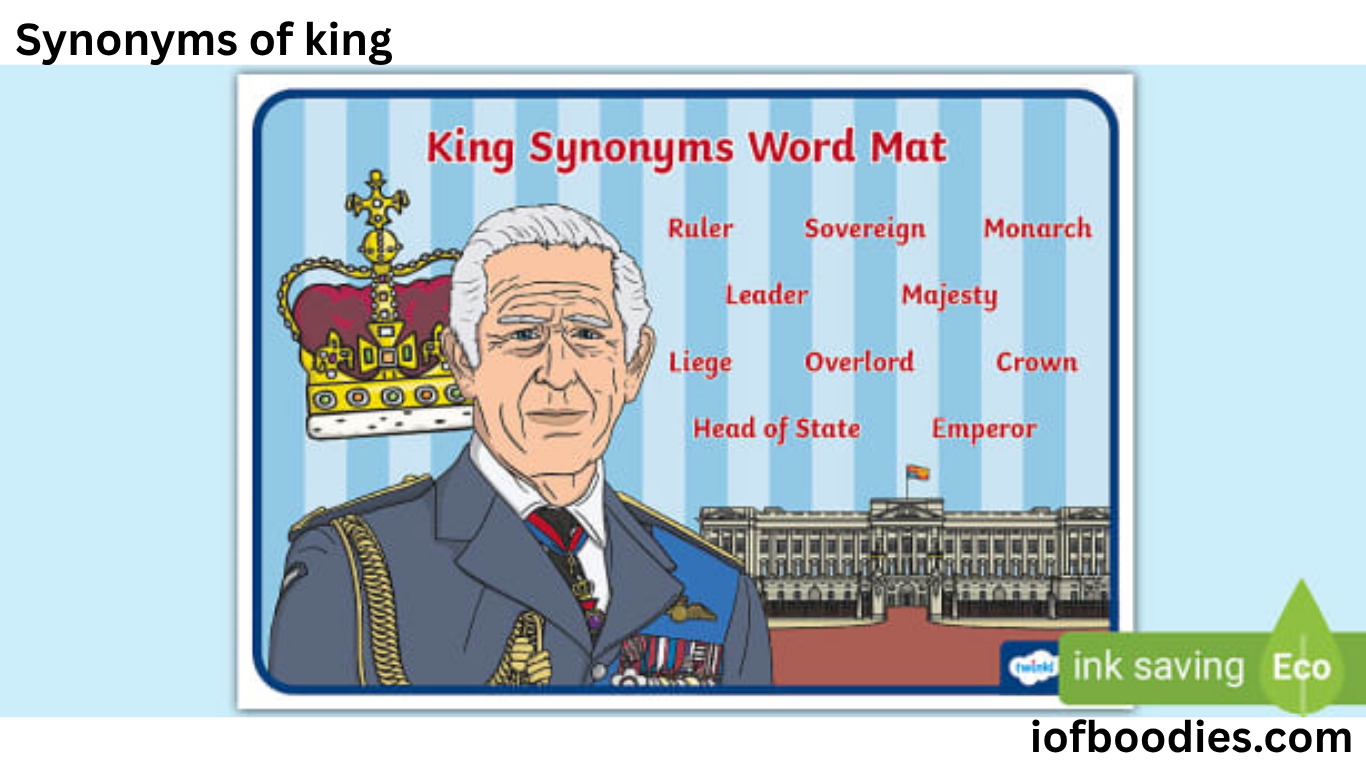
Synonyms of King: 50+ Words, Meanings, and Examples 👑📚
Synonyms of king include monarch, ruler, sovereign, emperor, sovereign lord, and royal leader. These words describe people who hold royal authority, lead a kingdom, or rule over a territory. However, each word has a slightly different meaning, and not every synonym can replace the word “king” in every sentence.
The word “king” is commonly used in history, literature, fairy tales, politics, and everyday expressions. It can describe a male monarch who rules a kingdom, but it can also be used informally to describe someone who is highly skilled or successful in a particular area. For example, a person might be called the “king of comedy” because of their popularity or talent. 🎭
In this guide, you will discover more than 50 synonyms of king, learn the meaning and history of the word, explore other names for a king, and understand the difference between a king, monarch, emperor, prince, and ruler. You will also find examples, related expressions, antonyms, and useful vocabulary for essays, conversations, and word games.
👑 What Is the Meaning of King?
A king is traditionally a male monarch who rules a kingdom. In a monarchy, the king may inherit the position through a royal family, although the exact rules depend on the country and its history.
The king’s authority can vary widely. In some countries, a king has a mostly ceremonial role. In others, a monarch may have significant political power. The title itself does not automatically tell us how much control the person has over the government.
For example, a king may represent a country at official events, support national traditions, and take part in ceremonies. In a different historical setting, a king may have led armies, made laws, collected taxes, and governed the territory directly.
Also read:Synonyms for Companion: 100+ Words, Meanings, and Examples 🤝
📖 Definition of King
The definition of king is a male ruler or monarch of a kingdom. The word can also be used figuratively for a person, animal, object, or activity considered especially important, powerful, or successful.
Examples:
- The king welcomed visitors to the royal palace.
- The king ruled the kingdom for many years.
- He is known as the king of chess in his local club.
- The lion is often called the king of the jungle in popular expressions.
The last two examples use “king” in a figurative way rather than describing a royal position.
🗣️ What Does King Mean in Everyday English?
In everyday English, “king” can have several meanings depending on context.
In history, it usually refers to a royal ruler. In stories, it may describe a powerful character who rules a fictional land. In sports and entertainment, it can be a nickname for a highly successful person. In games, it can refer to a specific playing piece or card.
For example, the king in chess is the most important piece to protect, even though it does not move as freely as some other pieces. In a deck of cards, the king is a face card.
Understanding the context helps you select the right king synonym.
🔎 50+ Synonyms of King
The best synonym for king depends on whether you mean a royal ruler, a powerful leader, a historical title, or a person who is especially successful at something.
Here is a useful list of king synonyms and related terms.
| Synonym or related term | Meaning | Example |
| Monarch | A ruler of a monarchy | The monarch greeted the visitors. |
| Sovereign | A supreme ruler or head of state | The sovereign attended the ceremony. |
| Ruler | A person who governs a territory or people | The ruler protected the kingdom. |
| Emperor | A ruler of an empire | The emperor governed a vast territory. |
| Potentate | A powerful ruler | The potentate controlled the region. |
| Royal | Connected with a king or royal family | The royal family attended the event. |
| Crowned head | A monarch or royal ruler | The crowned head welcomed the guests. |
| Head of state | The person who formally represents a country | The head of state visited the capital. |
| Royal sovereign | A monarch with royal authority | The royal sovereign addressed the court. |
| Liege lord | A lord to whom another person owes loyalty | The knight served his liege lord. |
| Lord | A title for a person with authority or noble status | The lord owned land near the castle. |
| High king | A ruler who holds authority over several smaller rulers | The high king united the territories. |
| Paramount ruler | A ruler with superior authority | The paramount ruler settled the dispute. |
| Supreme ruler | A person with the highest ruling authority | The supreme ruler issued a command. |
| Crown prince | The heir expected to become king in certain monarchies | The crown prince attended the meeting. |
| Royal leader | A general description of a leader from a royal family | The royal leader addressed the people. |
| Patriarch | A senior male leader, especially in a family or group | The patriarch guided the family. |
| Chief | A leader of a group or community | The chief met with neighboring leaders. |
| Chieftain | A leader of a tribe or community | The chieftain welcomed the travelers. |
| Tribal ruler | A ruler or leader of a tribe | The tribal ruler negotiated an agreement. |
| Warlord | A military leader who controls an area, often through force | The warlord controlled the territory. |
| Despot | A ruler who uses power in an oppressive way | The despot restricted public freedoms. |
| Tyrant | A ruler who uses cruel or unjust power | The tyrant punished his opponents. |
| Autocrat | A ruler with concentrated personal power | The autocrat made decisions without broad consultation. |
| Dictator | A leader who holds authoritarian power | The dictator controlled the government. |
| Leader | A person who guides or directs others | The leader united the people. |
| Governor | An official who governs a region or state | The governor managed the province. |
| Commander | A person who leads military forces | The commander led the army. |
| Sovereign ruler | A ruler with supreme authority over a territory | The sovereign ruler signed the order. |
| Royal patriarch | A senior male figure in a royal family | The royal patriarch advised the younger generation. |
| Crown holder | A descriptive phrase for a person who holds the crown | The crown holder attended the coronation. |
| Crowned ruler | A ruler who has been crowned | The crowned ruler addressed the court. |
| Realm’s ruler | A descriptive phrase for the ruler of a realm | The realm’s ruler defended the border. |
| Kingdom’s ruler | The person who rules a kingdom | The kingdom’s ruler met with advisers. |
| Kingpin | A leading or controlling person in a group or activity | She became the kingpin of the local business network. |
| Ace | A person who is exceptionally skilled at something | He is an ace at solving puzzles. |
| Champion | A person who wins or excels in a competition | She became the champion of the tournament. |
| Master | A person highly skilled in a subject or activity | He is a master of strategy. |
| Top performer | A person who performs extremely well | The top performer led the team. |
| Leading figure | A person with great influence | She is a leading figure in the industry. |
| Powerhouse | A person or group with great strength or influence | The company became a sports powerhouse. |
| Star | A highly successful or famous person | He is the star of the team. |
| Legend | A person admired for outstanding achievements | The player became a legend. |
| Icon | A widely admired or influential person | The musician is an icon of popular culture. |
| Mogul | A powerful and influential businessperson | The media mogul built a large company. |
| Mastermind | A person who plans or directs a complex activity | The mastermind organized the project. |
| Authority | A person recognized for knowledge or power | She is an authority on ancient history. |
| Expert | A person with extensive knowledge or skill | He is an expert at chess. |
| Champion ruler | A descriptive expression for a ruler known for defending a cause | The champion ruler became a figure in local stories. |
| Royal personage | A person of royal rank or status | The royal personage arrived at the palace. |
| Kingly figure | A person who resembles or represents a king | The actor played a kingly figure. |
Important: Some terms in this table are related words, not exact synonyms. “Emperor” is a distinct royal title, while “tyrant” and “dictator” describe forms of rule that may be oppressive. “Champion,” “expert,” and “legend” work only when “king” is used figuratively.
🏰 Another Word for King in Different Situations
Not every synonym fits every sentence. If you want to use another word for king, first decide what you are describing.
1. Monarch
“Monarch” is one of the closest and most accurate synonyms for king. It describes the head of a monarchy and can refer to a king or a queen.
Example:
The king addressed the nation.
Alternative:
The monarch addressed the nation.
This is especially useful in history books, news reports, and formal writing because it does not depend on the monarch’s gender.
2. Sovereign
“Sovereign” refers to a supreme ruler or a person who holds the highest authority in a state. It can be used as a noun or an adjective.
Example:
The sovereign welcomed the foreign delegation.
The word often sounds formal and may appear in legal, political, and historical writing.
3. Ruler
“Ruler” is a broad term for someone who governs a country, kingdom, region, or people. A ruler might be a king, queen, emperor, or another type of leader.
Example:
The ruler introduced new rules for the kingdom.
Use “ruler” when the exact royal title is unknown or does not matter.
4. Emperor
An emperor usually rules an empire, which may include multiple territories, kingdoms, or peoples. An emperor is not simply another name for every king.
Example:
The emperor controlled a large empire.
A king traditionally rules a kingdom, while an emperor’s authority may extend across several territories. Historical titles do not always follow a simple pattern, so the distinction depends on the specific political system.
5. Potentate
“Potentate” is a formal word for a powerful ruler. It is less common in everyday conversation but may appear in historical writing or literary descriptions.
Example:
The potentate held great authority over the region.
6. Crowned Head
“Crowned head” is a descriptive expression for a monarch. It is often used in formal writing or when discussing royal traditions.
Example:
The crowned head attended the state ceremony.
This phrase is more literary than conversational.
📚 Other Names for a King in History
Different societies have used different titles for rulers. These titles may be related to a king, but they do not always mean exactly the same thing.
High King
A high king is a ruler who holds authority over other kings or smaller territories. The term appears in discussions of certain historical and legendary political systems.
Sultan
A sultan is a ruler who holds a title used in several Muslim-majority societies and historical states. The meaning and political authority associated with the title have changed across time and place.
A sultan may be compared with a king in some contexts, but the two titles are not universally interchangeable.
Pharaoh
“Pharaoh” is the traditional title associated with the rulers of ancient Egypt. It is most suitable when discussing Egyptian history rather than using it as a general synonym for a modern king.
Czar or Tsar
“Tsar,” also spelled “czar,” was a title used by rulers of Russia and some other Slavic states. It is strongly associated with Russian history.
Kaiser
“Kaiser” is the German title historically used by German emperors. It is related to the English word “emperor,” rather than being a universal term for a king.
Maharaja
“Maharaja” is a South Asian royal title traditionally associated with a great king or prince. Its historical use varies by region and political period.
Raja
“Raja” is a South Asian title for a king, prince, or ruler. The exact status attached to the title depends on the historical setting.
Shah
“Shah” is a royal title historically associated with rulers of Iran and some Persian-influenced states. It is a culturally specific title, not a general replacement for every king.
Rex
“Rex” is the Latin word for “king.” It appears in historical, legal, and academic contexts, as well as in names and expressions derived from Latin.
These titles show that the idea of a king exists across many cultures, but the words used for royal authority reflect different histories and political traditions.
👑 King vs. Monarch vs. Emperor vs. Ruler
These four words are related, but their meanings are not identical.
| Word | Main meaning | Is it a direct synonym for king? |
| King | A male monarch traditionally ruling a kingdom | Yes |
| Monarch | A ruler of a monarchy, male or female | Usually |
| Emperor | A ruler of an empire | Sometimes related, but not identical |
| Ruler | Anyone who governs a territory or people | Broadly related |
| Sovereign | A supreme ruler or head of state | Often, depending on context |
| Prince | A royal title often associated with a royal family or a ruler of a principality | No, not usually |
| Sultan | A culturally specific royal or political title | Sometimes comparable |
| Tyrant | A cruel or oppressive ruler | No, because it adds a negative meaning |
| Dictator | A leader who holds authoritarian power | No, because it describes a political system or leadership style |
What Is the Difference Between a King and a Monarch?
A king is one kind of monarch. A monarch may be a king or a queen, so “monarch” is the broader term.
For example, if a country has a queen as its head of state, calling her “the monarch” is correct. Calling her “the king” would not normally be correct.
What Is the Difference Between a King and an Emperor?
A king traditionally rules a kingdom. An emperor traditionally rules an empire, which may contain multiple territories or peoples.
Also read:✨ Synonyms of Correct: 100+ Words, Meanings, and Examples
However, historical systems differ. Some emperors ruled territories that were not organized as a simple collection of kingdoms, and some kings held power over large areas. It is best to use the official historical title when discussing a particular ruler.
What Is the Difference Between a King and a Prince?
A prince is often a member of a royal family, a possible heir to a throne, or the ruler of a principality. A prince is not automatically a king.
A crown prince is often the recognized heir to a monarchy, although the rules of succession vary among countries.
📝 King Synonyms for Essays and Formal Writing
If you are writing an essay, report, or history assignment, select words that accurately describe the person and the political system.
“Monarch” is a strong choice when discussing royalty in general. “Sovereign” may work in a formal discussion of authority. “Ruler” is suitable when the precise title is not important. “Emperor” should be used when the person held that title or ruled an empire.
Examples:
- Original: The king ruled the kingdom for thirty years.
- Alternative: The monarch ruled the kingdom for thirty years.
- Original: The king had authority over the territory.
- Alternative: The sovereign held authority over the territory.
- Original: The king made decisions for the region.
- Alternative: The ruler made decisions for the region.
Avoid using “tyrant” unless you intend to suggest that the ruler used power cruelly or unjustly. Similarly, “dictator” carries a political meaning and should not be used only to avoid repeating the word “king.”
For school assignments, accuracy matters more than variety. Repeating “king” is better than choosing a synonym that changes the meaning.
🎭 Words to Describe a King
Sometimes the goal is not to find another name for a king but to describe the king’s personality, behavior, or leadership.
Here are useful descriptive words:
| Word | Meaning |
| Wise | Makes thoughtful decisions |
| Just | Tries to treat people fairly |
| Powerful | Has great authority or influence |
| Noble | Shows high moral character or has noble status |
| Courageous | Shows bravery |
| Generous | Willing to give or help |
| Respected | Admired by others |
| Benevolent | Wants to help others or promote their well-being |
| Authoritative | Shows or holds authority |
| Ambitious | Strongly wants to achieve goals |
| Proud | Has a strong sense of personal importance |
| Ruthless | Shows little concern for others when pursuing goals |
| Oppressive | Uses power to limit or control others unfairly |
| Charismatic | Attracts and influences people |
| Strategic | Plans carefully to reach a goal |
These are adjectives rather than synonyms for king. They help explain what kind of ruler a person is.
For example, “a wise king” describes a king who makes good decisions. “A tyrant” describes a ruler who uses cruel or oppressive power. The words communicate different ideas and should not be treated as interchangeable.
🧩 Synonyms for Emperor
The word “emperor” refers to a ruler of an empire. Its closest alternatives depend on the historical period and political system.
Common Emperor Synonyms
- Sovereign
- Monarch
- Imperial ruler
- Supreme ruler
- Potentate
- Emperor of an empire
- Imperial sovereign
Some of these are broader descriptions rather than exact synonyms. “Monarch” can refer to an emperor or a king, while “imperial ruler” emphasizes authority over an empire.
Another Word for Emperor in a Sentence
Original: The emperor visited the capital.
Alternative: The monarch visited the capital.
This works if the sentence does not require the exact title. If you are discussing a specific historical emperor, it is generally better to preserve the correct title.
Original: The emperor controlled several territories.
Alternative: The imperial ruler controlled several territories.
This alternative keeps the focus on the person’s imperial authority.
Emperor Thesaurus: Choosing the Right Word
When using a thesaurus, look at the definition and example sentence instead of selecting the first result. A word such as “dictator” may describe someone with authoritarian power, but it does not mean “emperor” in every situation.
The same rule applies to “potentate,” which is a formal word for a powerful ruler but does not identify a particular type of empire.
🌍 Synonyms of King in Hindi
The English word “king” can be translated into Hindi in several ways depending on the sentence.
| Hindi word | English meaning or use |
| राजा (Raja) | King or ruler |
| महाराजा (Maharaja) | Great king or traditional royal title |
| नरेश (Naresh) | King or ruler, often literary |
| भूपति (Bhupati) | A literary or traditional term for a ruler |
| सम्राट (Samrat) | Emperor |
| शासक (Shasak) | Ruler or governor |
| अधिपति (Adhipati) | Lord, master, or ruler, depending on context |
These words are related, but they do not all mean exactly the same thing. For example, “सम्राट” generally means “emperor,” while “राजा” is commonly translated as “king.”
If you are translating a sentence into Hindi, consider whether “king” means a royal ruler, a figurative champion, or a person with great influence. The right translation may change with the intended meaning.
🦍 Synonyms of King Kong
“King Kong” is the name of a fictional giant ape character. Because it is a proper name, it does not have direct synonyms in the same way as the common noun “king.”
If you mean words that describe King Kong as a character, possible descriptions include:
- Giant ape
- Giant gorilla-like creature
- Fictional giant monster
- Colossal ape
- Legendary giant creature
These are descriptions, not alternative official names for the character.
If your search for “synonyms of King Kong” is about writing, a phrase such as “the giant ape” may work when the reader already knows which character you mean. If you are discussing a specific movie or story, use the character’s established name for clarity.
🧠 Words With King in Them
Some people searching for king synonyms also want words containing the letters “king” or words that begin with “king.” These are related vocabulary searches, but they do not necessarily produce synonyms.
Examples of words containing “king” include:
- King
- Kings
- Kingly
- Kingship
- Kingmaker
- Kingpin
- Kingdom
- Kingfisher
- King-size
- Kingside
Words Starting With King
Examples include “king,” “kingly,” “kingship,” “kingmaker,” and “kingpin.”
Their meanings differ:
- “Kingly” means resembling or suitable for a king.
- “Kingship” refers to the position or status of being a king.
- “Kingmaker” describes a person who helps someone gain power or a leadership position.
- “Kingpin” can mean a leading or controlling person in an activity or organization.
- “Kingdom” refers to a territory ruled by a king or queen, and it also has other meanings in biology and general language.
These words are connected to “king,” but they should not be used as direct substitutes in a sentence about a royal ruler.
Also read:Synonyms for Believed: 50+ Better Words to Use in 2026 📚
🔤 King Etymology: Where Does the Word Come From?
The word “king” has a long history in the English language. It comes from Old English “cyning,” which referred to a king or ruler. Its earlier Germanic roots are connected with words used for royal leadership and kinship.
The history of the word reflects the importance of family, inheritance, and political authority in many early European societies. In some historical systems, kingship was closely connected to a royal family and the passing of authority from one generation to the next.
The modern English word has retained its central meaning, but its use has expanded. Today, “king” appears in historical discussions, fiction, games, nicknames, entertainment, and informal descriptions of exceptional skill.
King Etymology and Related Words
The word “kingship” describes the position, status, or institution of being a king. “Kingly” is an adjective that means royal or king-like. “Kingdom” describes a territory ruled by a king or queen, although it can also be used in other contexts.
These related words help explain the word family:
- King: a male monarch
- Kingship: the role or status of a king
- Kingly: resembling or associated with a king
- Kingdom: a territory or realm ruled by a monarch
- Kingmaker: someone who helps another person gain power
- Kingpin: a leading or controlling person
Understanding the word family is useful for vocabulary development because it shows how one root can form several words with different grammatical roles.
✍️ How Do You Spell King?
The word “king” is spelled K-I-N-G.
It has four letters and one syllable. The word begins with the “k” sound, followed by the short “i” sound and the ending “ng” sound.
A simple memory tip is to remember the phrase “king in a kingdom.” Both “king” and “kingdom” begin with the same four-letter word.
Common related forms include “kings,” “kingly,” “kingship,” and “kingdom.” Each form has its own meaning and grammatical use.
🧭 What Is the Opposite of King?
There is no single perfect opposite of “king” in every situation. The best answer depends on what aspect of the word you want to contrast.
King Antonyms in Royal Contexts
If “king” refers to a male monarch, “queen” may be a contrast in gender or royal title. However, a queen can also be a monarch, so she is not the opposite of monarchy itself.
If “king” refers to someone with royal authority, “commoner” may be a contrast between a royal person and someone without royal rank in a traditional class system.
If “king” is being used to mean a top performer, words such as “beginner,” “novice,” or “amateur” may provide a contrast in skill, although they are not direct antonyms.
| Word | How it contrasts with king |
| Queen | A different royal title, often for a female monarch |
| Commoner | A person without royal or noble status in a traditional system |
| Subject | A person governed by a monarch |
| Novice | A beginner, when king is used figuratively for an expert |
| Outsider | Someone outside a group, when king refers figuratively to a leading member |
Monarch Antonyms
“Monarch” does not have a simple direct antonym. Depending on the context, you might contrast a monarch with a commoner, a subject, or an elected official. These words describe different roles or political arrangements rather than exact opposites.
For example, “monarch” describes the type of head of state, while “president” usually describes an office in a republic. The comparison depends on the constitutional system.
🧩 What Is Another Word for King or Queen?
If you want a word that includes both a king and a queen, “monarch” is usually the best choice.
Other useful expressions include:
- Royal ruler
- Head of a monarchy
- Sovereign
- Crowned head
- Royal head of state
For example:
“The king and queen attended the ceremony.”
This can be rewritten as:
“The monarchs attended the ceremony.”
If you are referring to the royal couple together, you can also say “the royal couple” or “the king and queen.” “Monarch” usually refers to one ruler, while “monarchs” is the plural form.
Other Words for King and Queen in Formal Writing
In a formal history essay, “monarch” can reduce repetition when the gender of the ruler is not important. “Royal family” is suitable when discussing the wider family, but it is not a direct synonym for a single king or queen.
Choose the expression that matches the number of people and their role.
🧩 King Synonyms for Crossword Puzzles
People often search for “what to call a king crossword” because crossword answers depend on the number of letters and the clue’s wording.
Common possibilities include:
| Possible answer | Typical meaning |
| Rex | Latin for king |
| Tsar | A historical royal title |
| Shah | A historical title associated with rulers of Iran |
| Raja | A South Asian royal title |
| Czar | An alternative spelling of tsar |
| Monarch | A ruler of a monarchy |
| Ruler | A person who governs |
| Liege | A term associated with feudal loyalty and lordship |
The correct answer depends on the puzzle’s length and the exact clue. For example, “Rex” may fit a short clue asking for the Latin word for king, while “monarch” may fit a longer clue asking for a general royal ruler.
Do not assume that every crossword clue uses “king” in the literal royal sense. It may refer to a chess piece, a playing card, or a figurative champion.
💬 Words to Call a King: Titles and Forms of Address
The correct way to address a king depends on the country’s traditions and official protocol.
In some monarchies, “Your Majesty” is the formal form of address. When referring to the king in the third person, “His Majesty” may be used. These forms are common in English-language royal protocol, but practices differ among royal households and cultures.
In a fictional story, a writer may use expressions such as “Your Highness,” “Your Majesty,” or “my king.” The right choice depends on the world of the story, the relationship between the speakers, and the traditions being represented.
What Do You Call a King?
In general, you can call a king “the king,” “the monarch,” or “the ruler,” depending on context. In formal settings, the correct title and form of address should follow the relevant country’s protocol.
For a history assignment, use the title that the historical figure actually held. For creative writing, choose a form of address that fits the character and setting.
💭 Final Thoughts
Synonyms of king include monarch, sovereign, ruler, emperor, and potentate. The most suitable alternative depends on the meaning you want to express. “Monarch” is one of the closest general synonyms, “ruler” is broad and simple, and “sovereign” is often useful in formal writing.
Other historical titles, such as pharaoh, tsar, shah, sultan, raja, and maharaja, are connected to kingship but belong to particular cultures and political traditions. They should be used with attention to historical accuracy.
When writing an essay, choosing a synonym is not just about avoiding repetition. It is about preserving the correct meaning. A king is not automatically an emperor, a prince, a dictator, or a tyrant. Each word carries a different meaning and may describe a different type of position or leadership.
For everyday English, remember that “king,” “monarch,” and “ruler” are useful starting points. For more specific writing, choose the word that best matches the title, role, and historical context. 👑
❓ Frequently Asked Questions About Synonyms of King
What is the best synonym for king in English?
“Monarch” is one of the best general synonyms for king because it describes the ruler of a monarchy. “Ruler” is another useful option when the exact royal title is not important. “Sovereign” can work in formal or historical writing. The best choice depends on the sentence and the political system being described.
Can the word emperor be used instead of king?
Not always. A king traditionally rules a kingdom, while an emperor traditionally rules an empire. Although both are royal rulers, their titles may represent different levels or types of authority. When discussing a historical person, use the title that person actually held rather than replacing it automatically.
What is a female king called?
In ordinary modern English, a female monarch is generally called a queen. A queen may rule in her own right or hold the title through marriage, depending on the country’s royal system and traditions. The term “monarch” can refer to either a king or a queen without specifying gender.
What does kingly mean, and is it a synonym for king?
“Kingly” is an adjective meaning royal, majestic, or resembling a king. It describes qualities or appearances rather than naming the ruler directly. For example, “a kingly manner” means a manner that seems royal or dignified. Therefore, “kingly” is a related word, but it is not a direct synonym for the noun “king.”
What is the difference between kingship and kingdom?
“Kingship” refers to the role, status, or institution of being a king. “Kingdom” usually refers to the territory or realm governed by a king or queen. For example, a king may hold kingship over a kingdom. The words share a root, but they describe different things.