✨ Synonyms for Exclaimed: 50+ Words to Express Strong Feelings
Finding the right word to replace “exclaimed” can make your writing clearer, more expressive, and more interesting. Whether you are writing a story, creating dialogue, completing a school assignment, or describing someone’s reaction, choosing the right synonym helps readers understand how a person speaks and feels.
The best synonyms for exclaimed depend on the situation. Words such as “shouted,” “cried,” “declared,” “blurted,” “announced,” and “cheered” can express different emotions and speaking styles. Some suggest excitement, while others show surprise, anger, fear, or confidence.
For example, instead of writing, “She exclaimed happily, ‘We won!’” you could write, “She cheered, ‘We won!’” The word “cheered” gives readers a clearer picture of her excitement.
However, not every synonym works in every sentence. “Whispered” suggests a quiet voice, while “shouted” suggests a loud one. “Declared” often sounds firm or formal, while “blurted” suggests that someone spoke suddenly without thinking.
This guide explores synonyms for exclaimed, their meanings, examples, antonyms, and uses in dialogue. It also explains how to choose the best alternative for stories, essays, conversations, and everyday writing.
📚 What Are Synonyms for Exclaimed?
Synonyms for exclaimed are words or expressions that can replace “exclaimed” when describing a person’s speech. They often show that someone spoke with strong emotion, surprise, excitement, or emphasis.
Here are some common synonyms for exclaimed:
| Synonym | Meaning | Example |
| Shouted | Spoke in a loud voice | “Watch out!” he shouted. |
| Cried | Spoke or called out with strong emotion | “Help me!” she cried. |
| Declared | Stated something firmly | “I will finish this,” he declared. |
| Announced | Shared information publicly | “The winner is here,” she announced. |
| Blurted | Said something suddenly | “I forgot!” he blurted. |
| Exclaimed | Spoke suddenly or emotionally | “What a surprise!” she exclaimed. |
| Cheered | Expressed happiness or support | “We did it!” they cheered. |
| Protested | Spoke against something | “That is unfair!” he protested. |
| Called out | Spoke loudly enough to get attention | “Wait for me!” she called out. |
| Remarked | Made a comment | “That is interesting,” he remarked. |
| Gasped | Reacted with a sudden intake of breath, often before speaking | “You are here!” she gasped. |
| Replied | Answered someone | “Yes, I understand,” he replied. |
| Yelled | Spoke very loudly | “Come back!” she yelled. |
| Proclaimed | Announced something publicly or confidently | “Today is a new beginning!” she proclaimed. |
| Warned | Alerted someone to possible danger | “Watch your step!” she warned. |
These words are not always interchangeable. The right choice depends on the speaker’s emotion, the volume of the voice, the purpose of the statement, and the surrounding scene.
😊 Synonyms for Exclaimed Happily
When someone speaks with joy, excitement, or pleasure, use a word that makes the positive emotion clear.
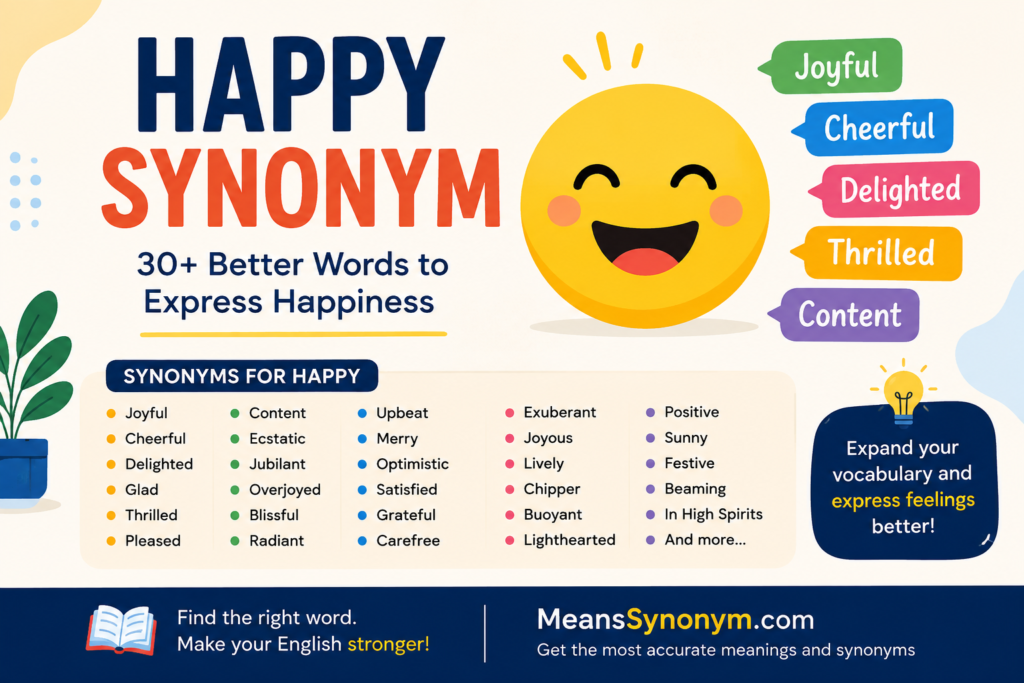
Common synonyms for exclaimed happily include:
- Cheered
- Celebrated
- Shouted joyfully
- Cried happily
- Gushed
- Rejoiced
- Exulted
- Beamed
- Exclaimed excitedly
- Called out happily
- Sang out
- Shouted with delight
Examples:
“It’s my birthday!” Mia cheered.
“We finally made it!” the hikers shouted joyfully.
“I love this gift!” Daniel gushed.
“Our team won the championship!” the fans celebrated.
“I got the job!” she cried happily.
“Look at the beautiful view!” he exclaimed excitedly.
Also read:Synonyms of King: 50+ Words, Meanings, and Examples 👑📚
Each alternative expresses happiness in a slightly different way. “Cheered” often suggests celebration or support. “Gushed” can suggest that someone is speaking with overflowing enthusiasm. “Rejoiced” is more formal and often describes great happiness.
The phrase “another word for said happily” can also lead to useful choices such as “cheered,” “exclaimed,” “gushed,” and “celebrated.” The best option depends on whether the person is celebrating, sharing exciting news, or reacting to something pleasant.
😲 Synonyms for Exclaimed in Surprise
Surprise can be positive, negative, or neutral. Someone may be surprised by a gift, a sudden noise, unexpected news, or an unfamiliar situation.
Useful synonyms include:
- Gasped
- Blurted
- Cried out
- Shouted
- Remarked in surprise
- Stammered
- Yelped
- Exclaimed in astonishment
- Repeated in disbelief
- Called out
Examples:
“You came all this way?” she gasped.
“I didn’t know you were coming!” he blurted.
“What happened here?” the teacher cried out.
“You finished the entire project?” Maya asked in disbelief.
“Is that really your new puppy?” Ben exclaimed.
Use “gasped” when the reaction includes a sudden intake of breath. Use “blurted” when the words come out unexpectedly. “Stammered” works when surprise makes a speaker hesitate or struggle to speak smoothly.
😠 Synonyms for Exclaimed in Anger
When a character is angry, the dialogue verb can show frustration, disagreement, or a strong objection.
Possible alternatives include:
- Shouted
- Yelled
- Snapped
- Barked
- Protested
- Objected
- Demanded
- Raged
- Roared
- Retorted
- Complained
- Rebuked
Examples:
“Stop touching my things!” she snapped.
“That is not what we agreed on!” he protested.
“Give me an answer!” the manager demanded.
“You cannot blame me for that!” Ava retorted.
“Get out of the road!” the driver yelled.
These words have different meanings. “Snapped” often suggests a short, sharp response. “Protested” emphasizes disagreement. “Demanded” shows that the speaker expects an answer or action.
“Roared” may suggest an extremely loud or forceful voice, while “complained” focuses on expressing dissatisfaction rather than necessarily speaking loudly.
😨 Synonyms for Exclaimed in Fear
Fear can cause people to call for help, shout a warning, or react suddenly.
Useful words include:
- Screamed
- Shrieked
- Yelped
- Cried out
- Shouted
- Called for help
- Whimpered
- Gasped
- Warned
- Stammered
Examples:
“Look behind you!” he shouted.
“Help!” she screamed.
“There’s something moving in the bushes!” Jake cried out.
“Don’t go near the edge!” the guide warned.
“I think someone is outside,” she whispered nervously.
“Whimpered” suggests a weak, frightened sound. “Shrieked” often describes a very high-pitched cry. “Warned” is useful when the speaker wants to alert someone to danger.
Choose the word that matches the intensity of the moment. Not every frightened person screams; some people speak quietly, hesitate, or call out for help.
💪 Synonyms for Exclaimed With Confidence
A confident speaker may make a strong statement, express certainty, or announce a decision.
Common options include:
- Declared
- Proclaimed
- Asserted
- Insisted
- Announced
- Affirmed
- Stated firmly
- Emphasized
- Maintained
- Vowed
Examples:
“I will complete the assignment,” she declared.
“We will find a solution,” the coach proclaimed.
“I know what I saw,” he insisted.
“This is the right decision,” the director asserted.
“I promise I will help,” Maya vowed.
“Declared” is a useful general alternative when a speaker makes a firm statement. “Asserted” emphasizes confidence in a claim. “Vowed” suggests a serious promise or commitment.
💬 Synonyms for Exclaimed in Dialogue
Dialogue is the written representation of what characters say. Writers often use dialogue tags to identify the speaker and show how a line is delivered.
For example:
“That’s amazing!” Sarah exclaimed.
The word “exclaimed” suggests an emotional reaction. However, using the same tag repeatedly can make dialogue feel repetitive.
A more precise verb may help:
“That’s amazing!” Sarah cheered.
“I don’t believe it!” Sarah gasped.
“Wait for me!” Sarah called out.
“That is my final answer,” Sarah declared.
The alternatives change the reader’s understanding of the moment. A dialogue tag should support the scene instead of distracting from it.
Common Dialogue Tags and Their Uses
| Dialogue tag | Best use | Example |
| Said | Neutral speech | “I am ready,” Anna said. |
| Exclaimed | Emotional or emphatic speech | “What a day!” Anna exclaimed. |
| Shouted | Loud speech | “Stop!” Anna shouted. |
| Whispered | Very quiet speech | “Come closer,” Anna whispered. |
| Asked | A question | “Are you ready?” Anna asked. |
| Replied | An answer | “Yes,” Anna replied. |
| Muttered | Low or unclear speech | “This is difficult,” Anna muttered. |
| Snapped | A sharp, irritated response | “Leave it alone,” Anna snapped. |
| Declared | A firm statement | “I will go,” Anna declared. |
| Blurted | Sudden, unplanned speech | “I broke it,” Anna blurted. |
| Gasped | Speech with a sudden breath | “You’re safe!” Anna gasped. |
| Protested | An objection | “That is unfair,” Anna protested. |
Writers do not need to replace every use of “said.” In many scenes, “said” is clear and natural. Use stronger dialogue tags when they add information that the reader needs.
How to Choose a Synonym for Exclaimed in Dialogue
First, identify what the character is doing. Is the character reacting, answering, warning, celebrating, or disagreeing?
Next, consider the voice. Is it loud, quiet, shaky, calm, or forceful?
Finally, check the surrounding dialogue. If the words already show the emotion, a simple tag may be enough.
For example:
“I’m so happy for you!” Lena said.
The sentence communicates happiness without a special tag.
“I’m so happy for you!” Lena cheered.
The second sentence suggests a more energetic reaction.
Neither is automatically better. The best version depends on the character, scene, and tone of the story.
📖 What Does Exclaimed Mean?
The word “exclaimed” is the past tense of the verb “exclaim.” It describes speaking suddenly or with strong feeling, often to express surprise, excitement, anger, or another emotion.
For example:
“What a wonderful surprise!” he exclaimed.
In this sentence, the speaker reacts with enthusiasm or surprise.
Exclaimed Meaning in Simple English
The simplest meaning of “exclaimed” is “said something with strong emotion.”
It often appears in stories, novels, plays, and other writing where a character reacts to something.
Examples:
“That’s incredible!” she exclaimed.
“Be careful!” he exclaimed.
“I can’t believe it!” they exclaimed.
The word does not always mean that someone shouted. A person can exclaim in surprise or excitement without speaking at the loudest possible volume.
Exclaimed Definition
A simple definition of “exclaimed” is:
Exclaimed: spoke suddenly or emphatically to express a feeling or reaction.
The word can be used when someone makes an emotional statement, calls something out, or reacts strongly to information.
For example:
“It’s finally finished!” the artist exclaimed.
The word highlights the artist’s reaction to completing the work.
What Is the Difference Between Exclaim and Exclaimed?
“Exclaim” is the base form of the verb. “Exclaimed” is its simple past tense and past participle.
| Word | Grammatical form | Example |
| Exclaim | Base form | People sometimes exclaim in surprise. |
| Exclaims | Present tense for he, she, or it | She exclaims whenever she sees a puppy. |
| Exclaimed | Simple past tense | He exclaimed when he heard the news. |
| Exclaiming | Present participle or gerund | She was exclaiming with excitement. |
These forms describe the same basic action but are used in different grammatical situations.
Exclaim Meaning and Definition
To exclaim means to say something suddenly or with strong feeling. It often signals that the speaker is reacting rather than simply sharing information.
Also read:Synonyms for Inside: 50+ Useful Words, Meanings, and Examples 🚪📚
Example:
“That’s unbelievable!” Mark exclaimed.
The statement expresses a strong reaction. Depending on the scene, it could show amazement, disbelief, or excitement.
The exact emotion is usually understood from the words and surrounding context.
What Does the Word Exclaimed Mean in a Sentence?
Consider this sentence:
“Watch out for the falling branch!” the woman exclaimed.
Here, “exclaimed” indicates an urgent reaction. The woman is calling attention to a possible danger.
Now consider:
“We won the competition!” the team captain exclaimed.
In this example, the word communicates excitement and celebration.
The same verb can fit different emotions. The context determines which feeling the reader understands.
🗣️ Exclaims Meaning and Definition
“Exclaims” is the present-tense form of “exclaim” used with a singular third-person subject, such as “he,” “she,” or “it.”
Examples:
- She exclaims with delight when she sees the decorations.
- He exclaims in surprise when the lights come on.
- The child exclaims whenever the dog performs a trick.
The word usually describes a reaction that happens in the present or repeatedly.
Exclaims Synonym
Possible synonyms for “exclaims” include:
- Shouts
- Cries out
- Announces
- Declares
- Calls out
- Proclaims
- Cheers
- Yells
The best option depends on the sentence.
For example:
“She exclaims with joy” could become “She cheers with joy.”
“He exclaims in surprise” could become “He cries out in surprise.”
“The speaker exclaims the result” might be better written as “The speaker announces the result,” depending on the intended meaning.
Another Word for Exclaims
If you need another word for “exclaims,” start by identifying the kind of speech.
Use “cheers” for enthusiastic celebration, “declares” for a firm statement, “calls out” for attracting attention, and “cries out” for a strong emotional reaction.
Avoid selecting a synonym based only on its intensity. A word that works in a dramatic scene may sound unnatural in a calm conversation.
✍️ Exclaiming Meaning and Definition
“Exclaiming” is the -ing form of “exclaim.” It can function as part of a verb phrase or as a noun-like gerund.
Examples:
- The children were exclaiming with excitement.
- Exclaiming during the announcement made the speaker’s enthusiasm clear.
- She kept exclaiming about the beautiful scenery.
The word suggests that someone is speaking with strong feeling or emphasis.
Synonyms for Exclaiming
Depending on the context, synonyms for exclaiming may include:
- Shouting
- Calling out
- Cheering
- Crying out
- Declaring
- Proclaiming
- Yelling
- Exclaiming excitedly
These alternatives are not exact replacements in every sentence.
For example, “cheering” usually suggests support or happiness, while “yelling” emphasizes loudness. “Declaring” focuses on making a firm statement.
Define Exclaiming in a Sentence
To define exclaiming in a sentence, explain that it is the act of speaking suddenly or emotionally.
Example:
“The children were exclaiming about the surprise party.”
This sentence suggests that the children were reacting with excitement.
❗ Exclamation Synonyms and Related Words
An exclamation is a sudden or emphatic expression of feeling. It can also refer to a sentence or phrase that expresses a strong reaction.
Related words include:
- Outcry
- Cry
- Shout
- Interjection
- Protest
- Declaration
- Cheer
- Exclamation of surprise
- Exclamation of joy
- Exclamation of anger
These words are related, but their grammatical roles differ.
“Exclaim” is a verb. “Exclamation” is a noun. “Exclamatory” is an adjective that describes something expressing strong feeling or emphasis.
For example:
“That’s wonderful!” is an exclamation.
“She exclaimed that the news was wonderful” uses the verb.
“The sentence has an exclamatory tone” uses the adjective.
Exclamatory Synonym
Depending on the sentence, alternatives for “exclamatory” may include:
- Emphatic
- Emotional
- Expressive
- Excited
- Forceful
- Enthusiastic
These words do not mean exactly the same thing. “Emphatic” focuses on emphasis, while “enthusiastic” suggests excitement or interest.
↔️ Antonyms for Exclaimed
An antonym is a word with an opposite or contrasting meaning. Because “exclaimed” describes a way of speaking, it does not have one perfect opposite for every situation.
The best antonym depends on what aspect of the word you want to contrast.
Common Antonyms for Exclaimed
| Word | How it contrasts with exclaimed | Example |
| Whispered | Suggests very quiet speech | She whispered her answer. |
| Murmured | Suggests soft, low speech | He murmured a response. |
| Mumbled | Suggests unclear speech | She mumbled an apology. |
| Muttered | Often suggests low or dissatisfied speech | He muttered under his breath. |
| Said calmly | Removes strong emotional emphasis | She said calmly that everything was fine. |
| Stated neutrally | Focuses on plain information | He stated the facts neutrally. |
| Remained silent | Contrasts with speaking | She remained silent. |
“Whispered” is not a direct antonym in every case because a person can whisper with strong emotion. However, it can contrast with a loud exclamation.
Similarly, “remained silent” is an opposite in terms of whether speech occurs at all, rather than a direct lexical opposite of the verb.
Exclaimed Antonym in a Sentence
Original:
“That’s incredible!” he exclaimed.
Also read:Synonyms for Companion: 100+ Words, Meanings, and Examples 🤝
Contrasting version:
“That is the information,” he stated calmly.
The second sentence removes the emotional emphasis. It is a contextual contrast rather than a perfect dictionary antonym.
Opposite of Exclaim
The opposite of “exclaim” depends on the intended meaning.
If you mean speaking loudly, “whisper” may provide a contrast. If you mean speaking with strong emotion, “state calmly” may work better. If you mean speaking at all, “remain silent” is the clearest contrast.
Choose an opposite based on the sentence rather than assuming that one word works in every situation.
🔤 How to Spell Exclaimed Correctly
The correct spelling is “exclaimed.”
It contains the letters E-X-C-L-A-I-M-E-D.
A common mistake is to leave out a letter or change the order of the vowels. For example, “exclamed,” “exclaime,” and “excalimed” are incorrect spellings of the intended word.
How to Remember the Spelling
Start with the base word “exclaim.” Then add “-ed” to form the past tense: exclaim + ed = exclaimed.
Remember that the base word ends with “m.” The correct spelling keeps that letter before the “-ed” ending.
Correct: exclaimed
Incorrect: exclamed
Correct: exclaiming
Incorrect: exclaming
Learning the base word can help you spell related forms correctly, including “exclaim,” “exclaims,” and “exclaiming.”
Common Misspellings of Exclaimed
| Incorrect spelling | Correct spelling |
| Exclamed | Exclaimed |
| Exclaime | Exclaim |
| Exclames | Exclaims |
| Exclain | Exclaim |
| Exclaimes | Exclaims |
| Excalimed | Exclaimed |
Some misspellings occur because people type quickly or remember the sound without remembering the exact letter sequence.
If you are editing an article or story, check the word carefully. A spelling checker can help, but a final read-through is useful because automated tools may not catch every error in context.
📝 Synonyms for Exclaimed in Different Types of Writing
The most effective synonym depends not only on emotion but also on the type of writing.
In Fiction and Short Stories
Fiction writers use dialogue tags to make scenes easy to follow. Words such as “gasped,” “snapped,” “cheered,” and “whispered” can show a character’s reaction.
Example:
“There’s a letter for you!” Nina called out.
“From whom?” David asked.
“Your old friend!” Nina replied.
The dialogue tags help readers understand who is speaking and what is happening without adding lengthy explanations.
However, too many unusual tags can make a story feel forced. Use a simple tag when it works, and choose a more specific one when the scene benefits from it.
In School Essays
In an essay, “exclaimed” may be suitable when discussing a quotation or describing a character’s emotional statement.
For formal writing, words such as “stated,” “declared,” “asserted,” and “announced” may be more precise when the speaker is presenting information rather than reacting emotionally.
Example:
“The principal announced the new schedule.”
This sentence is more direct than saying the principal “exclaimed the new schedule,” unless the principal’s emotional delivery is important.
In News Writing
News writing generally values clarity and accuracy. “Announced,” “said,” “stated,” and “confirmed” are often useful when describing public statements.
Example:
“The mayor announced a new transportation plan.”
“Exclaimed” may be appropriate when a person’s emotional reaction is part of the story, but it can sound subjective if the emotion is not clearly supported by the situation.
In Creative Dialogue
Creative dialogue allows a wider range of words because the writer may want to show mood, personality, or tension.
Example:
“Don’t open that door!” Marcus warned.
“Why not?” Elena asked.
“Because I heard something inside,” he whispered.
Each verb serves a distinct purpose. “Warned” communicates danger, “asked” introduces a question, and “whispered” indicates quiet speech.
The verbs help shape the scene without requiring the narrator to explain every feeling.
In Everyday Writing
For everyday messages, simple verbs are often enough.
Instead of writing:
“I am very happy about the news,” she exclaimed.
You might write:
“I am so happy about the news!” she said.
Or:
“I am so happy about the news!” she cheered.
The first alternative is neutral. The second emphasizes happiness. Both can be correct depending on the tone you want.
🎯 How to Choose the Best Synonym for Exclaimed
Choosing the right word is easier when you consider four questions.
1. What Emotion Is the Speaker Expressing?
Start with the feeling. Is the speaker happy, surprised, frightened, angry, or confident?
For happiness, consider “cheered” or “gushed.” For surprise, consider “gasped” or “blurted.” For anger, consider “snapped” or “protested.”
The emotion narrows your options.
2. How Loud Is the Voice?
Some words describe volume more clearly than emotion.
“Yelled” and “shouted” suggest loud speech. “Whispered” suggests quiet speech. “Muttered” suggests low or unclear speech.
Do not use a loud-speaking verb if the scene describes a quiet response unless the contrast is intentional.
3. What Is the Speaker Trying to Do?
A person may be answering, warning, announcing, objecting, celebrating, or making a promise.
Use “replied” for an answer, “warned” for danger, “announced” for sharing information, and “protested” for disagreement.
This helps you choose a word that describes the action, not just the emotion.
4. Does the Word Fit the Tone?
A formal speech may suit “declared” or “proclaimed.” A casual conversation may work better with “said,” “called out,” or “blurted.”
Consider the character’s age, personality, setting, and relationship with other speakers. A word that feels natural in one scene may sound unusual in another.
📋 Quick Reference: Another Word for Exclaimed
Use this quick guide when you need a synonym for exclaimed.
| If you mean… | Try… |
| Said something happily | Cheered, gushed, celebrated |
| Reacted with surprise | Gasped, blurted, cried out |
| Spoke loudly | Shouted, yelled, called out |
| Spoke angrily | Snapped, protested, retorted |
| Warned someone | Warned, shouted, called out |
| Made a firm statement | Declared, asserted, proclaimed |
| Shared information publicly | Announced, reported, stated |
| Answered a question | Replied, responded, answered |
| Spoke quietly | Whispered, murmured, muttered |
| Expressed fear | Screamed, shrieked, whimpered |
| Expressed disagreement | Objected, protested, challenged |
| Made a casual comment | Remarked, commented, observed |
The table is a starting point, not a list of exact replacements. Always check how the word sounds in the full sentence.
🌟 Final Thoughts
Synonyms for exclaimed help writers express emotion, volume, and intention more clearly. Words such as “shouted,” “gasped,” “cheered,” “declared,” “blurted,” and “protested” can make dialogue more precise when they match the situation.
The most useful synonym is not necessarily the strongest or most dramatic word. It is the word that helps readers understand what the speaker is doing and how the moment feels.
When writing dialogue, identify the speaker’s emotion, consider the volume of the voice, and choose a verb that fits the action. Use simple words when they are enough, and save more expressive alternatives for moments when they add real meaning.
Remember that “exclaim” is the base form, “exclaims” is the present-tense form used with a singular third-person subject, “exclaimed” is the past tense, and “exclaiming” is the -ing form. Knowing these forms makes it easier to use the word correctly in different sentences.
Whether you are looking for synonyms for exclaimed happily, synonyms for exclaimed in dialogue, an antonym for exclaimed, or a simple definition, the best choice depends on context. Clear writing comes from selecting the right word for the message, not from replacing every common verb with a more complicated one.
❓ Frequently Asked Questions
Is “exclaimed” appropriate in formal writing?
Yes, but it depends on the purpose of the sentence. “Exclaimed” works when a speaker expresses a strong reaction or emotion. In formal reports, academic writing, or news articles, a more neutral word such as “stated,” “announced,” or “said” may be clearer when the emotional reaction is not important.
Can “exclaimed” be used without quotation marks?
Yes. A writer can describe an exclamation without quoting the exact words. For example, “He exclaimed in surprise when he saw the result.” Quotation marks are generally used when the writer includes the speaker’s exact words, following the style conventions of the text.
Is “exclaimed” stronger than “said”?
Usually, “exclaimed” suggests more emotion or emphasis than “said.” However, the difference depends on context. “Said” is neutral and can be used in almost any conversation, while “exclaimed” highlights a reaction. Neither word is always better; choose the one that communicates the intended meaning.
Can an object or animal exclaim?
In ordinary writing, “exclaim” most often describes a person speaking. Writers may use it creatively for fictional characters, talking animals, or personified objects. For example, in a children’s story, a talking clock might exclaim, “It’s time to go!” In factual writing, use the word carefully so the sentence remains clear.
How can I avoid repeating “exclaimed” too often in a story?
First, check whether every dialogue line needs a special tag. Sometimes “said,” “asked,” or no additional tag is enough when the speaker is clear. When a specific action matters, choose a precise alternative such as “warned,” “cheered,” “gasped,” or “protested.” You can also show emotion through the character’s actions and the surrounding description rather than relying on a different dialogue tag every time.