Weird or Wierd: Which Spelling Is Correct?
If you are unsure whether the correct spelling is “weird” or “wierd,” you are not alone. This is one of the most common spelling questions in English because the word does not follow the spelling pattern many people expect.
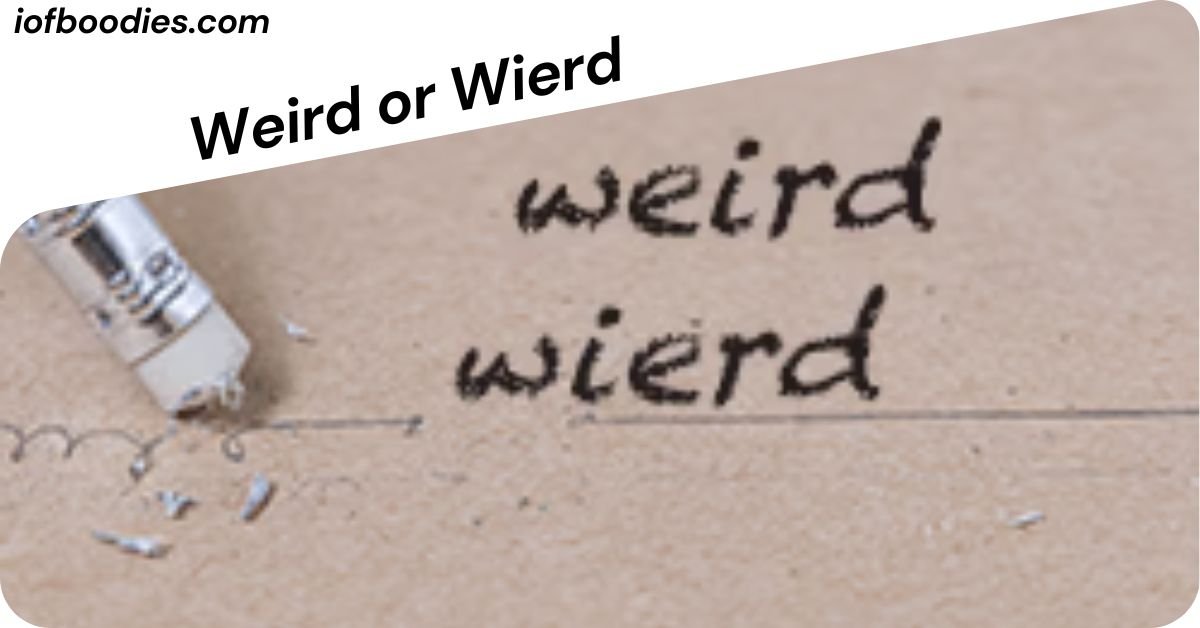
The correct spelling is “weird.”
“Weird” is the standard English spelling used in American English and other major forms of English. “Wierd” is a common misspelling. Although people may understand what “wierd” means when they see it, it is not the standard spelling used in formal English.
This guide explains the difference between weird and wierd, why the word is often misspelled, how to remember the correct spelling, how to use weird in a sentence, and how related forms such as weirdly and weirded are used. It also covers common variations such as weired, weirdd, weerd, wiered, wird, weirdt, weirdr, weid, wied, weerdy, and other informal or incorrect forms.
The goal is simple: by the end of this article, you should know exactly when to use “weird” and why “wierd” is incorrect in standard English.
Weird or Wierd: The Correct Spelling
The correct spelling is “weird.”
The spelling “wierd” is incorrect in standard English.
For example:
- Correct: That was a weird experience.
- Incorrect: That was a wierd experience.
Another example:
- Correct: The movie had a weird ending.
- Incorrect: The movie had a wierd ending.
If you are writing an email, school assignment, business document, website, application, report, or professional message, use “weird.”

Quick Answer
If you need the answer quickly:
“weird” is correct.
“wierd” is a common spelling mistake.
A useful way to remember it is:
“I before E, except after C” is not a rule that works perfectly for every English word. “Weird” is one of the famous exceptions.
So do not change “weird” to “wierd” simply because “i before e” is a familiar spelling pattern.
What Does Weird Mean?
The word “weird” is an adjective. It generally describes something unusual, strange, unexpected, or different from what people normally experience.
For example:
- That is a weird sound.
- She had a weird dream.
- The weather has been weird today.
- It was weird to see the store completely empty.
- He has a weird sense of humor.
The meaning can be positive, negative, neutral, or humorous depending on the context.
For example, saying “That is weird” might mean something is confusing or unusual. In another situation, “That is weird” might be playful and mean something is interesting or pleasantly unusual.
The meaning depends heavily on tone and context.
Why Do People Spell Weird as Wierd?
The spelling “wierd” is common because English spelling can be difficult to predict.
Many English learners remember spelling patterns such as “i before e.” This can make “wierd” feel natural because the letters appear to fit a familiar pattern.
However, “weird” is one of the words that does not follow that simple pattern.
The correct sequence is:
W-E-I-R-D
The incorrect common form is:
W-I-E-R-D
The difference is only the position of the “I” and “E,” but that small difference changes the spelling.
Another reason people make this mistake is pronunciation. In many accents, the vowel sounds in “weird” do not make the spelling obvious. When people write a word based on how it sounds, they may choose “wierd” because it looks more familiar.
Typing habits can also contribute. People often type quickly on phones and computers, and spell-check systems may not always be noticed or used.
Weird vs. Wierd: A Simple Comparison
| Spelling | Correct? | Explanation |
| weird | Yes | Standard English spelling |
| wierd | No | Common misspelling |
| weired | No | Incorrect form often created by adding “-ed” incorrectly |
| wiered | No | Misspelled version |
| weirdd | No | Usually a typing or informal spelling error |
| weerd | No | Not the standard spelling of “weird” |
| wird | No | Different spelling and not the standard word |
| weirdt | No | Not the standard spelling |
| weirdr | No | Not a standard spelling |
| weid | No | Misspelling |
| wied | No | Misspelling |
| weerdy | No | Nonstandard form |
The key point is that “weird” is the standard spelling.
How to Remember the Spelling of Weird
One of the easiest ways to remember “weird” is to memorize the letters as a group:
WEIR
Think:
WEIR + D = WEIRD
Another useful method is to remember that “weird” is an exception to the common “I before E” spelling expectation.
You can also connect the spelling with a familiar phrase:
Also Read: Receive or Recieve: Which Spelling Is Correct?
“weird” has “weir” at the beginning.
For example:
- weird
- weirder
- weirdest
- weirdly
- weirdness
Once you remember the base word “weird,” many of its related forms become easier to spell.
A Simple Memory Trick
Try this:
“WEIRD starts with WEI.”
Then picture the word:
W-E-I-R-D
The important part is the middle:
E-I
Not:
I-E
So when you are deciding between weird and wierd, remember:
WEI = correct.
WIE = incorrect.
Is Weird a Real English Word?
Yes. “Weird” is a standard English word with a long history.
It is used in everyday conversation, literature, journalism, education, business communication, entertainment, and online communication.
The word has also changed in meaning over time.
Historically, “weird” was associated with fate or destiny. In older English, the word could refer to something connected with fate or supernatural forces. Over time, its meaning developed into the modern sense of something strange, unusual, or uncanny.
This history is one reason the word is particularly interesting from a language perspective.
Today, most people use “weird” to mean unusual, strange, unexpected, or difficult to explain.
The History of the Word Weird
The history of “weird” goes much further back than its modern meaning.
The word is related to an old English term associated with fate, destiny, or what happens to a person. It became especially well known through literary and cultural references involving the “Weird Sisters” in William Shakespeare’s “Macbeth.”
In that older context, “weird” had a connection to fate rather than simply meaning strange.
Over many years, the meaning changed.
Modern English speakers usually do not use “weird” to mean fate. Instead, they use it to describe something unusual or strange.
Language often changes in this way. Words can keep their spelling while their everyday meanings develop.
That makes “weird” an interesting example of how English vocabulary evolves.
Weird in Modern American English
In the United States, “weird” is a common everyday word.
People may use it in casual conversations such as:
“That was weird.”
“That is a weird idea.”
“Why is the computer acting weird?”
“The food tasted weird.”
“She gave me a weird look.”
The word is usually easy to understand and does not require formal language.
However, “weird” can sometimes sound judgmental depending on how it is used.
For example, calling someone’s behavior “weird” may suggest that the person is strange or different from what the speaker considers normal.
For this reason, professional writers may sometimes choose more precise words such as:
- unusual
- unexpected
- uncommon
- unfamiliar
- unconventional
- surprising
- unusual-looking
- confusing
The best word depends on the intended meaning.
Is Wierd Ever Correct?
In standard English, “wierd” is generally considered a misspelling of “weird.”
You may encounter “wierd” online, in usernames, social media posts, informal messages, comments, or user-generated content. Its appearance does not make it the accepted spelling.
Internet users sometimes intentionally change spellings for usernames, branding, humor, or stylistic reasons. A person or website may use a nonstandard spelling as a creative choice.
That is different from saying the spelling is correct in standard English.
If you are completing an academic assignment or professional document, use “weird.”
Weird and Weired: What Is the Difference?
“Weired” is another common mistake.
The correct base word is:
weird
When people try to create a past-tense form by adding “-ed,” they may write:
weired
However, “weired” is not the normal standard form.
The verb “weird” is uncommon compared with the adjective “weird,” and when the verb is used, the form “weirded” can occur.
For example:
“The strange event weirded him out.”
However, this form is much less common in everyday writing than phrases such as:
“The strange event made him uncomfortable.”
Because “weird” is primarily familiar as an adjective, people may be unsure about its grammatical forms.
What Does Weirded Mean?
“Weirded” is a form of the verb “weird.”
It is often seen in the expression “weirded out,” which means made uncomfortable, nervous, confused, or uneasy because something seemed strange.
For example:
“The strange noise weirded me out.”
“She was weirded out by the unexpected message.”
This expression is informal.
In professional writing, you may prefer:
“The strange noise made me uncomfortable.”
“The unexpected message made her uneasy.”
The choice depends on the level of formality you need.
What Does Weirdly Mean?
“Weirdly” is an adverb formed from “weird.”
It describes an action or situation that happens in a strange, unusual, or unexpected way.
Examples include:
- Weirdly, nobody noticed the mistake.
- The machine was working weirdly.
- He was weirdly calm during the emergency.
- The room was weirdly quiet.
“Weirdly” is a standard English word.
It can be used in both informal and more general writing, although the exact tone depends on the sentence.
Weirdness: Another Related Word
“Weirdness” is a noun that refers to the quality or condition of being weird.
For example:
“The weirdness of the situation made everyone laugh.”
“The movie is known for its unusual style and weirdness.”
The word “weirdness” is correctly formed from “weird.”
This gives you a useful word family:
- weird
- weirdly
- weirdness
- weirder
- weirdest
- weirded
- weirding
Not every form is equally common, but the base spelling remains “weird.”
Weird, Weirder, and Weirdest
The adjective “weird” can be compared using “weirder” and “weirdest.”
Examples:
- This is weird.
- That situation is weirder.
- That was the weirdest thing I have ever seen.
These forms follow a common English pattern for short adjectives.
When spelling these words, keep the original “weird” sequence:
WEIRD
WEIRDER
WEIRDEST
Do not change the order of the “E” and “I.”
Common Misspellings of Weird
Many people search for different versions of the same word because they are unsure about its spelling.
Some common variations include:
- wierd
- weired
- wiered
- weirdd
- weerd
- weerdy
- wird
- weirdt
- weirdr
- weid
- wied
The most important thing to understand is that these variations do not replace the standard spelling “weird.”
Some may appear because of:
- typing mistakes
- pronunciation-based spelling
- autocorrect errors
- fast texting
- language learning
- uncertainty about English spelling rules
- usernames or online handles
- deliberate creative spelling
When writing standard English, choose “weird.”
What About Weired?
“Weired” is generally an incorrect spelling when someone is trying to write “weird” or a related form.
The problem usually comes from uncertainty about how the word changes when an ending is added.
Instead of automatically adding letters to the base word, consider the intended grammar.
For example:
Correct:
“The situation was weird.”
Possible informal verb form:
“The situation weirded him out.”
Not standard:
“The situation weired him out.”
Learning the base word first can prevent many related spelling mistakes.
What About Weerd?
“Weerd” is not the standard spelling of “weird.”
You may see “weerd” in informal online writing, names, usernames, or typing errors.
If your intended meaning is “strange” or “unusual,” the standard word is:
weird
This distinction matters in professional communication because spelling errors can affect how polished and trustworthy a document appears.
What About Weirdd?
“Weirdd” is usually a typing mistake or intentional informal spelling.
The standard spelling has only one “D” at the end:
weird
Adding another “D” does not create a standard English word.
If you see “weirdd” online, the context may help explain why the person used it, but it should not be used in formal English.
What About Weerdy?
“Weerdy” is not a standard English spelling of a common form of “weird.”
A person might create “weerdy” as an informal variation, username, nickname, or playful spelling.
However, if you are trying to write the standard English adjective, use “weird.”
What About Wird, Weid, and Wied?
Forms such as “wird,” “weid,” and “wied” can appear in searches because users sometimes type words according to sound or memory.
They are not standard spellings of the adjective meaning strange or unusual.
When your intended word is the adjective “weird,” write:
W-E-I-R-D
The correct spelling is more reliable than trying to reconstruct the word from pronunciation.
Weird Pronunciation and Spelling
The pronunciation of “weird” can make spelling difficult.
English spelling is not always a direct representation of pronunciation. Several letters may work together to produce a sound that is not obvious to a learner.
This is why listening to the word is not always enough to determine its spelling.
For English learners, it is helpful to learn frequently misspelled words as complete vocabulary items.
Instead of thinking:
“I need to figure out how to spell this sound,”
think:
“The word is WEIRD.”
This approach can make spelling faster and more accurate.
Why English Has So Many Difficult Spellings
English has developed from several language traditions, including Germanic, French, Latin, Greek, and other influences.
As a result, English spelling contains many historical patterns that do not always match modern pronunciation.
There are also many exceptions to simple spelling rules.
The popular phrase “I before E except after C” is a useful memory aid for some words, but it is not a complete rule for English spelling.
Examples such as “weird” show why learners should not depend on one spelling rule for every word.
Other familiar examples of unusual spelling patterns include words such as:
- their
- foreign
- height
- either
- neither
- science
- leisure
English spelling is often best learned through repeated exposure and practice.
How to Use Weird in a Sentence
Here are several examples using “weird” correctly:
- That was a weird dream.
- The old house has a weird sound at night.
- It would be weird to leave without saying goodbye.
- The computer started acting weird.
- She had a weird feeling about the situation.
- The movie has a weird but interesting ending.
- That is a weird question.
- The weather has been weird this week.
- I heard a weird noise outside.
- The conversation became weird after that comment.
These examples show that “weird” can describe experiences, objects, behavior, sounds, feelings, situations, ideas, and events.
Weird vs. Strange
“Weird” and “strange” are similar, but they are not always identical.
“Weird” often sounds more informal and conversational.
For example:
“That movie was weird.”
“That movie was strange.”
Both sentences are understandable, but “weird” can sound more casual.
“Strange” may also sound more neutral in some professional or formal contexts.
Depending on your audience, you could also use:
- unusual
- unexpected
- uncommon
- unfamiliar
- unconventional
- peculiar
- surprising
The best choice depends on what you want to communicate.
Is Weird a Negative Word?
Not necessarily.
“Weird” can have a negative meaning, but it can also be neutral or positive.
For example:
“The situation was weird.”
This may suggest discomfort or confusion.
But:
“I love weird movies.”
Here, “weird” may mean creative, unusual, or different.
Also Read: Kibard: Everything You Need to Know
Similarly:
“She has a weird sense of humor.”
This could be criticism, affection, or simply an observation.
Context and tone are important.
When Should You Avoid the Word Weird?
There is nothing inherently wrong with using “weird,” but professional writers should consider whether a more precise word would communicate the idea better.
For example, instead of:
“The report contains weird numbers.”
You could write:
“The report contains unusual numbers.”
Even better, if you know the problem:
“The report contains several inconsistent figures.”
The second sentence provides more information.
Good writing is not only about correct spelling. It is also about choosing words that communicate clearly.
Weird in Professional Writing
In business communication, “weird” can sometimes sound too informal.
For example:
“The customer’s behavior was weird.”
A more professional version might be:
“The customer’s behavior was unusual.”
Or:
“The customer’s behavior differed from the expected pattern.”
The appropriate choice depends on the audience.
In a casual email, “weird” may be perfectly acceptable. In a research paper, report, legal document, or formal business analysis, a more precise term may be better.
Weird in Academic Writing
Students often ask whether “weird” is acceptable in school writing.
The answer depends on context.
In a personal essay or creative assignment, “weird” may work very well.
In a formal academic paper, consider whether a more specific word would be stronger.
For example:
Less precise:
“The experiment produced a weird result.”
More precise:
“The experiment produced an unexpected result.”
Even better:
“The experiment produced a result that differed significantly from the predicted outcome.”
The goal is not to avoid “weird” completely. The goal is to use the word when it accurately matches your intended meaning.
Weird in Digital Communication
Online communication has created many new spelling habits.
People often shorten words, repeat letters, remove punctuation, or intentionally misspell words.
You may therefore see forms such as:
- weirdd
- weirdt
- weirdr
- weerd
- weerdy
- wierd
- weired
These forms may appear in usernames, comments, gaming communities, social media posts, text messages, or other informal spaces.
However, online usage should not be confused with standard dictionary spelling.
A spelling can become common online without becoming the accepted spelling in formal English.
Search Intent Behind “Weird or Wierd”
People searching for “weird or wierd” usually have a simple informational goal: they want to know which spelling is correct.
The search may happen while someone is:
- writing an email
- completing homework
- editing an article
- posting on social media
- filling out an application
- writing a story
- learning English
- checking a spelling mistake
- proofreading a document
The search phrase is therefore a spelling and grammar query.
The shortest useful answer is:
“Weird” is correct. “Wierd” is a common misspelling.
Additional information becomes useful when the reader wants to understand why the mistake happens and how to avoid repeating it.
Why Spelling Accuracy Matters
Spelling may seem like a small detail, but it affects communication.
A single spelling mistake usually does not prevent someone from understanding a sentence. However, repeated errors can make writing harder to read.
In professional settings, spelling can also affect the impression a document creates.
Correct spelling can help make writing appear:
- clear
- careful
- professional
- trustworthy
- polished
- easier to understand
This does not mean every typo is serious. Everyone makes mistakes. The important point is to proofread important writing before publishing or sending it.
How to Avoid the Weird or Wierd Mistake
The easiest solution is to memorize the correct spelling.
Remember:
WEIRD
Not:
WIERD
You can also use these strategies:
1. Save the Correct Spelling
Write “weird” several times.
Repeated exposure helps build visual memory.
2. Use a Spelling Tool
Modern word processors and browsers often identify common spelling mistakes.
However, do not rely entirely on automatic correction.
3. Read More English
Seeing correctly spelled words repeatedly helps you recognize the correct form.
4. Learn Word Families
Remember:
weird
weirdly
weirdness
weirder
weirdest
The repeated “weird” pattern reinforces the spelling.
5. Proofread Slowly
When checking your writing, pay special attention to words that you frequently misspell.
A Better Way to Learn Difficult English Words
One useful learning strategy is to treat spelling as visual pattern recognition rather than only a set of rules.
For “weird,” focus on the four-letter sequence:
WEIR
Once that sequence becomes familiar, the full word is easier to remember.
This method works for many difficult English words.
Instead of trying to memorize a complicated explanation, create a small mental image of the word.
For example:
WEIR + D = WEIRD
Then use it repeatedly in real sentences.
Weird or Wierd: Common Questions
Is “weird” or “wierd” correct?
“Weird” is correct. “Wierd” is a common misspelling.
Why is “wierd” wrong?
The standard spelling places the “E” before the “I”: W-E-I-R-D.
Is “wierd” accepted in English?
It may appear in informal online writing, but it is not the standard spelling of the word meaning strange or unusual.
Is “weird” an adjective?
Yes. “Weird” is commonly used as an adjective to describe something strange, unusual, or unexpected.
What is the easiest way to remember “weird”?
Remember the sequence “WEIR.” Then add “D”: WEIR + D = WEIRD.
Frequently Asked Questions About Weird and Wierd
1. Is “weird” one of the hardest English words to spell?
“Weird” is widely known as a commonly misspelled English word because its spelling does not match the simple “I before E” pattern many people learn. However, whether it is one of the hardest words depends on the writer’s language background and spelling experience.
2. Can spell-check change “wierd” to “weird” automatically?
Many modern spelling tools can identify “wierd” as a likely misspelling and suggest “weird.” However, automatic correction is not guaranteed in every application, browser, keyboard, or language setting. It is still useful to know the correct spelling yourself.
3. Does “weird” have different meanings in different English-speaking countries?
The basic modern meaning is broadly understood across major varieties of English. It generally refers to something strange, unusual, or unexpected. Differences may occur in tone, frequency, or preferred alternatives rather than in the core meaning.
4. Can “weird” be used as a noun?
Historically, “weird” had noun-related uses connected with fate or destiny, but modern everyday English usually uses “weird” as an adjective. In ordinary writing, it is safest to use it as an adjective unless you are intentionally discussing its historical or literary meaning.
5. Is “weird” suitable for children learning English?
Yes. “Weird” is a common vocabulary word and can be useful for English learners. Teachers can introduce it alongside related words such as “strange,” “unusual,” “different,” and “unusual-looking.” Because the spelling is irregular, learners should memorize its letter pattern.
Common Mistakes to Watch For
When writing “weird,” watch for these errors:
“wierd”
This is the most common spelling mistake.
“weired”
This often results from incorrectly adding letters to the word.
“wiered”
This combines two common spelling mistakes.
“weirdd”
This usually adds an unnecessary second “d.”
“weerd”
This changes the vowel spelling.
“weerdy”
This is not the standard form of the word.
“wird”
This does not represent the standard spelling of “weird.”
“weid”
This is another common typing or memory-based variation.
“wied”
This is also incorrect when the intended word is “weird.”
The safest approach is to return to the base spelling:
WEIRD.
SEO and Digital Literacy: Why Correct Spelling Matters Online
Spelling questions are especially common in online searches because people frequently type words before they fully know how they are spelled.
Search engines can often understand misspellings and provide corrected results. This is useful, but it can also create confusion.
For example, someone searching for “wierd” may still receive information about “weird.”
That does not mean “wierd” has become the correct spelling.
Search engines are designed to understand user intent. They may interpret a misspelled query and show results for the word the user probably meant.
This is an important digital literacy lesson:
Search results do not automatically prove that every spelling used in a query is correct.
When accuracy matters, compare the spelling with a reliable dictionary, style guide, educational resource, or trusted language reference.
How Search Engines Handle Misspellings
Modern search systems are designed to interpret natural language.
If you type “wierd or weird,” the search engine can often understand that you are asking about spelling.
This is helpful because users do not need perfect spelling to find information.
However, search correction can hide mistakes.
A person may type a misspelled word, receive the correct word in the results, and assume both forms are acceptable.
For educational and professional writing, it is better to identify the standard spelling directly.
In this case:
Correct: weird
Common misspelling: wierd
Weird and Autocorrect
Autocorrect can be useful, but it is not a substitute for learning spelling.
Different devices and applications use different dictionaries and correction systems. A system may recognize a common error, ignore it, or even introduce an unintended change.
When writing important content, read the complete sentence after using autocorrect.
This is particularly important when writing:
- business emails
- resumes
- school papers
- applications
- websites
- reports
- customer communications
- public posts
Technology can help you proofread, but human review remains valuable.
Expert Writing Tip: Focus on Meaning, Not Just Spelling
Correct spelling is important, but good communication involves more than spelling.
Compare:
“That was weird.”
with:
“That result was unexpected because the system had previously produced consistent results.”
The first sentence is simple and conversational.
The second is more informative and precise.
Neither sentence is automatically better. The right choice depends on the situation.
A strong writer chooses words based on audience, purpose, tone, and meaning.
That is a more useful writing skill than simply avoiding spelling mistakes.
The Role of Context in Using Weird
Context determines whether “weird” sounds friendly, neutral, humorous, or negative.
For example:
“That is a weird joke.”
This may be criticism.
“I like weird jokes.”
This may show a preference for unusual humor.
“That was a weird coincidence.”
This is often neutral and expresses surprise.
“The software is acting weird.”
This usually means the software is behaving unexpectedly.
Understanding these differences can help English learners communicate more naturally.
Weird as an Informal Word
“Weird” is widely used in everyday American English.
It appears in conversations, entertainment, online discussions, informal writing, and popular culture.
It is not normally considered offensive by itself. However, using “weird” to describe a person can sometimes be insensitive, depending on the situation.
If you want to be neutral, alternatives such as “unusual,” “unconventional,” or “different” may be more appropriate.
Good communication considers not only what a word means but also how it may make another person feel.
Is Weird a Formal Word?
“Weird” is a standard English word, but it is often associated with casual or conversational language.
That does not mean it is grammatically incorrect or unsuitable in all formal writing.
A formal writer can use “weird” when the context calls for it, particularly when quoting someone or discussing the concept itself.
Still, professional writing often benefits from specific language.
Instead of saying:
“The data looks weird.”
A technical writer might say:
“The data contains several anomalies.”
Instead of:
“The result was weird.”
A researcher might write:
“The result was unexpected.”
Precision usually improves formal writing.
A Quick Editing Checklist for Weird
Before publishing or submitting your writing, check the following:
- Did I spell it “weird”?
- Did I accidentally write “wierd”?
- Did I accidentally write “weired”?
- Am I using the word to describe something unusual?
- Would a more precise word improve the sentence?
- Does the tone fit my audience?
- Have I checked related forms such as “weirdly” and “weirdness”?
- If the document is formal, is “weird” the best word for the intended meaning?
These simple checks can prevent common errors.
Also Read: Homecz: The Home Connection Z Tech Framework for Smarter Living
Weird or Wierd: Final Verdict
The answer is straightforward:
Use “weird.”
Do not use “wierd” in standard English.
The spelling is:
W-E-I-R-D
The most common mistake reverses the “E” and “I”:
W-I-E-R-D
Although “wierd” appears frequently online, it remains a common misspelling rather than the standard form.
The word “weird” is an established English adjective meaning strange, unusual, unexpected, or unconventional. It has a long linguistic history and has developed from an older meaning connected with fate and destiny.
Related forms include “weirdly,” “weirdness,” “weirder,” and “weirdest.” The informal expression “weirded out” also appears in everyday American English.
For students, professionals, English learners, bloggers, and anyone writing online, the easiest strategy is to memorize the visual pattern:
WEIR + D = WEIRD.
Conclusion
The “weird or wierd” spelling question has a very simple answer: “weird” is correct, while “wierd” is a common misspelling.
The confusion mainly comes from English spelling patterns and the familiar expectation that “i” should come before “e” in certain words. “Weird” does not follow that simple pattern, so it is best learned as a complete spelling rather than guessed from a general rule.
Remember the four letters at the center of the word:
WEIR
Add the final D:
WEIRD.
The word is commonly used in American English to describe something strange, unusual, unexpected, or unconventional. Its related forms include “weirdly,” “weirdness,” “weirder,” and “weirdest.”
Whether you are writing a school assignment, professional email, website article, social media post, or everyday message, using “weird” will give you the standard spelling.
When in doubt, remember:
“Weird” is weirdly spelled, but it is definitely spelled WEIRD.