Receive or Recieve: Which Spelling Is Correct?
If you have ever stopped while writing an email, school assignment, business message, or social media post and wondered whether the correct spelling is “receive” or “recieve,” you are not alone. This is one of the most common spelling questions in English.
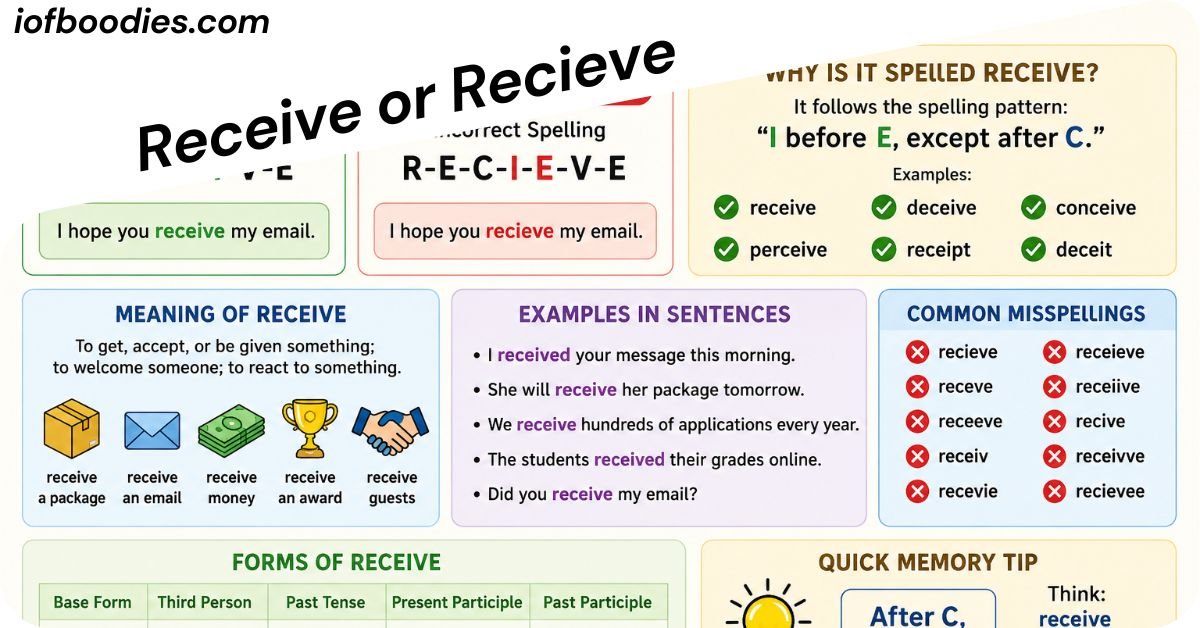
The correct spelling is receive.
The spelling recieve is incorrect in standard English. Although “recieve” looks natural because of the common “i before e” spelling pattern, the word receive follows the part of that rule that says “i before e, except after c.” Merriam-Webster explains that receive belongs to a group of words such as perceive, conceive, and deceive that use “ei” after the letter c.
This guide explains the difference between receive and recieve, the meaning of receive, how to remember the spelling, common mistakes, pronunciation, grammar, examples, related words, and practical tips for avoiding the error.
Receive or Recieve: Which Is Correct?
The correct spelling is receive.
The incorrect spelling is recieve.
Here is the simple comparison:
| Spelling | Correct? | Example |
| receive | Yes | I hope you receive my email. |
| recieve | No | I hope you recieve my email. |
If you are writing in standard American English, use receive.
The word receive is a standard English verb. It means to get, accept, or be given something. For example, you can receive a letter, receive a package, receive an email, receive money, receive an award, or receive information. Cambridge Dictionary defines receive as getting or being given something and also lists other meanings, such as formally welcoming someone or reacting to something in a particular way.
Merriam-Webster also defines receive as coming into possession of something or acquiring it. Its dictionary entry traces the word through Middle English and Anglo-French to the Latin recipere.
Why Is Receive Spelled With “ei”?
The spelling of receive becomes easier to understand when you look at the letter c.
The word is spelled:
receive
The important part is:
cei
It is not:
cie
A useful memory rule is:
“I before E, except after C.”
This means that when the letters i and e appear together after c in this type of word, the usual spelling is ei.
Examples include:
- receive
- deceive
- conceive
- perceive
- receipt
- deceit
- conceit
For example:
I will receive the package tomorrow.
She will receive an award.
They received the message this morning.
The company received several applications.
However, it is important not to treat “i before e, except after c” as a perfect English spelling rule. Merriam-Webster points out that the rhyme has many exceptions, including words such as seize, height, weird, and science.
Also Read: Kibard: Everything You Need to Know
For that reason, the best approach is to use the rule as a memory aid rather than as an absolute law.
Why Is “Recieve” Such a Common Misspelling?
The misspelling recieve is common because English spelling does not always match pronunciation in a simple way.
When people hear receive, they may focus on the sound of the long “ee” vowel. They may then remember the familiar pattern “i before e” and write recieve.
There is another reason this mistake happens: many common English words contain “ie.”
Examples include:
- believe
- achieve
- piece
- field
- friend
- chief
Because learners see these words frequently, they may assume the same order applies to receive.
But receive belongs to a different spelling group.
Compare:
believe
receive
The first uses ie.
The second uses ei.
The pronunciation does not make the spelling difference obvious. This is why visual memory can be more useful than pronunciation when learning this word.
Receive Meaning in Simple English
The simplest meaning of receive is “to get something.”
For example:
I received a letter.
This means:
I got a letter.
She received a gift.
This means:
Someone gave her a gift, and she got it.
We received your application.
This means:
Your application came to us, and we got it.
The word can be used for physical things, digital information, money, messages, opportunities, awards, and many other things.
Cambridge Dictionary gives “to get or be given something” as a primary meaning of receive.
Receive Definition
Receive is a verb.
A basic definition is:
Receive means to get, accept, or take something that is given, sent, offered, or directed to you.
Examples include:
- receive a gift
- receive a letter
- receive an email
- receive a payment
- receive an award
- receive information
- receive a phone call
- receive an invitation
- receive a package
- receive instructions
The word has several other meanings depending on context.
For example, a person can receive guests, meaning they welcome them.
A radio can receive a signal.
A person can receive criticism, meaning they experience or respond to it.
A sports player can receive a ball or serve.
Merriam-Webster lists meanings that include acquiring something, accepting something, welcoming someone, experiencing something, and receiving signals.
Receive Pronunciation
In American English, receive is pronounced approximately:
ri-SEEV
The pronunciation can be represented as /rɪˈsiːv/.
The main stress is on the second syllable.
The word sounds like “ree-seev” in everyday speech.
The spelling can seem confusing because the “ei” combination does not look like the spelling learners may expect from the sound.
For example:
receive → ri-SEEV
deceive → di-SEEV
perceive → per-SEEV
conceive → con-SEEV
These words share a similar spelling pattern.
Receive as a Verb
Receive is normally used as a verb.
A verb describes an action, event, or state.
Examples:
I receive emails every morning.
She received a package yesterday.
They will receive their certificates next week.
We are receiving new information.
He has received several messages.
Notice that receive changes form depending on tense and grammar.
The main forms are:
- receive
- receives
- received
- receiving
These forms are important because the spelling changes in different ways.
Receive, Receives, Received, and Receiving
The base form is receive.
Example:
I receive many emails.
With he, she, or it in the present tense, use receives.
Example:
She receives many emails.
The past tense is received.
Example:
She received an email yesterday.
The present participle is receiving.
Example:
She is receiving an email.
The word receiving is also spelled with ei:
receiving
Not:
recieving
This is another common spelling mistake.
How to Spell Receive Correctly
A simple way to spell receive is to break it into parts:
re + ceive
The complete spelling is:
r-e-c-e-i-v-e
There are two e letters around the “i”:
recei ve
The easiest visual pattern to remember is:
cei
Think of receive as a word with “ei” after c.
Another useful strategy is to connect receive with related words.
For example:
receive → receipt
receive → recipient
receive → reception
These words can help reinforce the “cei” pattern.
However, not every related word has exactly the same spelling pattern, so it is still useful to learn each word individually.
Receive or Recieve: Easy Memory Trick
If you often confuse receive and recieve, use this sentence:
“After C, use EI.”
The word receive has a c immediately before ei.
So:
r-e-c-e-i-v-e
You can also remember:
C + EI = receive
Another memory sentence is:
“I receive after C.”
This reminds you that the “ei” comes after c.
You can also connect the word with deceive and perceive.
receive
deceive
perceive
conceive
These words share the same general spelling pattern.
Examples of Receive in Sentences
Here are simple examples showing how receive is used.
I received your message this morning.
Did you receive my email?
She will receive her package tomorrow.
We receive hundreds of applications every year.
He received a birthday card from his friend.
The students received their grades online.
The company received a large payment.
You should receive a confirmation email soon.
They received an invitation to the event.
I did not receive the information.
She receives a newsletter every week.
The customer received the wrong item.
The school received new computers.
We received good news today.
He received an award for his work.
These examples show why receive is such a useful everyday word.
Receive in American English
Receive is standard in American English.
It is commonly used in business, education, technology, government, healthcare, customer service, and everyday communication.
For example, an American business may write:
You will receive a confirmation email after your order is processed.
A school may write:
Students will receive their results by email.
A bank may write:
You will receive a notification when the payment is complete.
A friend may write:
Did you receive my text?
The spelling does not change between American and British English.
Receive is spelled receive in both varieties.
Receive in Email and Digital Communication
The word receive is especially common in modern digital communication.
People receive:
- emails
- text messages
- notifications
- files
- photographs
- videos
- online payments
- security codes
- invitations
- digital documents
- account alerts
For example:
I did not receive the verification code.
Did you receive the attachment?
You should receive an email shortly.
The customer received a notification.
Because receive appears frequently in online communication, spelling it correctly is useful in both professional and personal writing.
A misspelling such as recieve may be understood by readers, but it can make formal writing look less polished.
Receive in Professional Writing
Correct spelling matters more in professional communication because small errors can affect how readers judge the quality of a message.
Consider these two sentences:
Please confirm that you received the document.
Please confirm that you recieved the document.
The second sentence contains a spelling error.
Although the meaning is clear, the first version is more professional.
This matters in:
- job applications
- resumes
- cover letters
- business emails
- reports
- academic papers
- customer service messages
- official documents
- workplace communication
Using receive correctly is a small detail, but accurate spelling contributes to clear communication.
Receive in Academic Writing
Students often use receive in school and college writing.
Examples include:
Students receive feedback from their teachers.
Researchers receive data from several sources.
Participants received instructions before the study.
The university receives applications throughout the year.
Because academic writing often requires careful proofreading, knowing the correct spelling can prevent an easy mistake.
If you are unsure whether to write receive or recieve, stop and check the spelling before submitting your work.
Receive vs. Recieve: Quick Answer
If you need the answer quickly, remember this:
Receive is correct.
Recieve is incorrect.
Correct:
I hope you receive the package.
Incorrect:
I hope you recieve the package.
The correct spelling contains “ei” after c.
receive
The incorrect spelling changes the order:
recieve
Is “Recieve” a Word?
In standard modern English, recieve is not the accepted spelling of the verb receive.
You may see recieve in online comments, social media posts, informal messages, school work, or other user-generated content. Its appearance does not make it a correct dictionary spelling.
It is best treated as a misspelling.
If a spell checker underlines recieve, change it to receive.
Online writing sometimes contains many spelling errors because people type quickly, use mobile keyboards, rely on autocorrect, or do not proofread. A misspelled form can become visually familiar without becoming correct.
This is one reason it is useful to compare a questionable spelling with a reliable dictionary.
Common Misspellings of Receive
The related keywords people may type when they are unsure about the spelling include:
- receve
- receeve
- receiv
- recevie
- receieve
- receiive
- recive
- receivve
- recievee
These forms are misspellings or incomplete forms rather than standard spellings of the word.
The correct form is:
receive
This is important for search behavior as well as writing accuracy. People often type a word the way they think it sounds or the way they remember its letters. Search engines and spell-check systems can often identify the intended word, but writers should still learn the standard spelling.
Why People Search “Receive or Recieve”
The search query “receive or recieve” usually reflects a spelling-checking intent.
Someone may already know the meaning of the word but feel uncertain about its spelling.
For example, a person might be writing:
I will receive the package tomorrow.
Before finishing the sentence, they may wonder whether receive or recieve is correct.
This type of search is common because English contains many words whose spelling cannot be predicted perfectly from pronunciation.
The best response is simple:
Use receive.
The “I Before E” Rule and Receive
The traditional rhyme is:
“I before E, except after C.”
Receive is one of the most familiar examples that illustrates the “except after C” part.
The spelling is:
r-e-c-e-i-v-e
The i comes before e in the word, but after c the order is ei.
Other examples include:
- deceive
- conceive
- perceive
- receipt
- deceit
- conceit
However, remember that the rule has many exceptions.
Merriam-Webster specifically notes that “i before e, except after c” is useful for identifying a common pattern but does not work as a universal rule.
This is an important lesson about English spelling: rules can help, but memorizing common words is often necessary.
Receive and Its Word Family
Learning related words can make spelling easier.
The word family around receive includes several useful terms.
Receive means to get or accept something.
Receiver can refer to a person or device that receives something.
Recipient refers to a person who receives something.
Reception can refer to the act of receiving, a welcome, or an area where visitors are received.
Received is the past tense and past participle of receive.
Receiving is the present participle.
Examples:
The recipient received the award.
The receiver accepted the signal.
The receptionist welcomed the visitor.
The package was received yesterday.
The company is receiving new applications.
Seeing these words together can strengthen your memory of the spelling.
Receive vs. Accept
Receive and accept can sometimes appear similar, but they are not always interchangeable.
Receive generally means that something comes to you or is given to you.
Accept often means that you agree to take something or agree that something is satisfactory or true.
Also Read: Homecz: The Home Connection Z Tech Framework for Smarter Living
For example:
I received the invitation.
This tells us that the invitation came to me.
I accepted the invitation.
This tells us that I agreed to attend.
A person can receive something without accepting it.
For example:
She received the offer but did not accept it.
This distinction is useful in professional and everyday English.
Receive vs. Get
Receive and get can also have similar meanings.
Receive is often more formal.
For example:
I got your email.
I received your email.
Both sentences can be correct.
The second sounds more formal and is common in business communication.
Another example:
We got the documents yesterday.
We received the documents yesterday.
The second version may be preferred in a formal report or business email.
Receive vs. Obtain
Receive and obtain are related but have different meanings.
Receive often suggests that something is given, sent, delivered, or comes to you.
Obtain often suggests that you actively get something through effort or action.
For example:
I received a letter from the company.
I obtained a copy of the report.
The first sentence focuses on something being sent to the person.
The second focuses more on the person’s action in getting the report.
Choosing the right word makes writing more precise.
How to Avoid the Receive Spelling Mistake
The easiest way to avoid writing recieve is to create a visual memory.
Remember:
receive
Not:
recieve
A useful technique is to type the word several times correctly:
receive
receive
receive
receive
You can also write short sentences:
I receive emails.
I received a package.
I will receive the results.
She receives updates.
The more often you see and use the correct spelling, the easier it becomes to remember.
Another useful strategy is to associate receive with the word receipt.
Both contain the “cei” pattern after c.
receive
receipt
This connection can help you remember the letter order.
Common Grammar Mistakes With Receive
Spelling is not the only possible problem. Some writers also use receive incorrectly in a sentence.
One common issue is forgetting the third-person singular ending.
Incorrect:
She receive many emails.
Correct:
She receives many emails.
Another mistake is using receive when received is needed.
Incorrect:
I receive the package yesterday.
Correct:
I received the package yesterday.
The correct form depends on the time of the action.
Present:
I receive emails every day.
Past:
I received an email yesterday.
Future:
I will receive an email tomorrow.
Present continuous:
I am receiving an email now.
Present perfect:
I have received the email.
Receive in Different Tenses
Understanding the different forms can make the word easier to use.
Present Tense
I receive messages every day.
They receive regular updates.
Third-Person Singular
He receives a monthly report.
She receives many emails.
Past Tense
We received the package yesterday.
He received a phone call.
Future Tense
You will receive the results soon.
They will receive their tickets by email.
Present Continuous
She is receiving new information.
The system is receiving data.
Present Perfect
I have received your message.
They have received the documents.
Past Perfect
She had received the letter before the meeting.
Future Perfect
You will have received the confirmation by then.
The spelling of the base word remains important across these forms.
Receive in Technology
The word receive has an important meaning in technology.
Devices receive signals and data.
For example:
A phone receives a wireless signal.
A television receives a broadcast signal.
A computer receives data from a server.
A device can receive a notification.
In this context, receive does not necessarily mean receiving a physical object. It means accepting or taking in information or a signal.
Cambridge Dictionary includes the meaning of receiving radio or television signals and describes receiving a person’s voice through radio communication.
This broader meaning shows why receive remains an important word in modern English.
Receive in Sports
Receive is also used in sports.
A player can receive a ball.
A tennis player can receive a serve.
A football player can receive a pass.
A volleyball player can receive the ball.
For example:
The receiver caught the pass.
The player moved into position to receive the serve.
Cambridge Dictionary includes sports-related uses of receive, including receiving a ball and receiving serve.
Receive in Business
Businesses use receive frequently.
Companies receive:
- payments
- orders
- applications
- invoices
- complaints
- requests
- emails
- documents
- customer feedback
- deliveries
Examples:
The company received your application.
We received your payment.
The office received the documents.
The customer received a refund.
The business will receive the shipment tomorrow.
Correct spelling is particularly useful in customer-facing communication because mistakes can affect the professional appearance of a company.
Receive in Customer Service
Customer service messages often use receive to confirm that information has arrived.
For example:
We have received your request.
We received your complaint and are reviewing it.
You should receive a response within two business days.
Once we receive your payment, we will process your order.
This type of wording is common because receive is neutral, clear, and professional.
Receive in Formal English
Receive can sound more formal than get.
Compare:
We got your application.
We received your application.
The second sentence is generally more appropriate for an official message.
For formal writing, receive is often useful because it clearly describes the arrival or acceptance of something without sounding overly casual.
How Spell Check Can Help With Receive
Modern writing tools can help identify spelling mistakes.
If you type recieve, many word processors and browsers may underline it or suggest receive.
However, spell check should not replace language learning.
Automatic tools can sometimes miss errors or misunderstand what you intended to write.
For example, if you type a correctly spelled word in the wrong context, a basic spell checker may not identify the problem.
A good editing process is:
- Write your sentence.
- Review the spelling.
- Check the grammar.
- Read the sentence aloud.
- Confirm the meaning.
- Use a trusted dictionary when uncertain.
This approach is especially useful for professional and academic writing.
Search Engine Intent Behind “Receive or Recieve”
The keyword “receive or recieve” has a clear informational search intent.
A person searching it usually wants a quick answer to a spelling question.
The ideal answer should therefore appear early:
Receive is correct. Recieve is incorrect.
After the direct answer, a useful article can explain why, provide examples, and offer memory techniques.
This structure is also helpful for search engines because it directly addresses the user’s question before providing additional educational detail.
Featured Snippet Answer: Receive or Recieve
The correct spelling is receive.
Recieve is a common misspelling. Receive contains “ei” after the letter c, following the familiar “i before e, except after c” spelling pattern. Examples include receive, deceive, conceive, and perceive. However, the spelling rule has exceptions and should be treated as a memory aid rather than a perfect rule.
People Also Ask: Is Recieve Correct?
No. Recieve is not the standard spelling.
The correct spelling is receive.
Example:
Correct: I received your email.
Incorrect: I recieved your email.
People Also Ask: How Do You Spell Receive?
The correct spelling is:
R-E-C-E-I-V-E
The word contains “ei” after c.
A simple way to remember it is:
re + ceive
People Also Ask: Why Is Receive Not Spelled Recieve?
Receive is spelled with “ei” because the letters i and e appear after c.
This follows the familiar spelling pattern commonly summarized as “i before e, except after c.”
However, English has many exceptions, so this should not be treated as an absolute rule.
People Also Ask: What Is the Past Tense of Receive?
The past tense is received.
Example:
I received your message yesterday.
The word received is spelled with the same “ei” pattern:
r-e-c-e-i-v-e-d
People Also Ask: What Is the Difference Between Receive and Recieve?
Receive is the correct English spelling.
Recieve is a misspelling.
The difference is the order of the letters i and e.
Correct:
receive
Incorrect:
recieve
Tips for Students Learning Receive
Students can use several simple methods to remember this word.
First, write the correct spelling repeatedly.
Second, connect receive with words such as deceive and perceive.
Third, remember that the “ei” comes after c.
Fourth, use the word in real sentences.
For example:
I receive homework every Monday.
I received my test results.
I will receive my certificate next month.
Fifth, use a dictionary when you are uncertain.
Oxford Learner’s Dictionaries recommends looking up a word when spelling is uncertain and provides dictionary entries, usage information, pronunciation guidance, and other learning resources.
Tips for English Learners
English learners often find receive difficult because spelling and pronunciation do not always match.
A useful learning method is to focus on patterns rather than individual letters.
Learn these together:
receive
deceive
conceive
perceive
Then learn their meanings.
For example:
receive = get something
deceive = trick someone
conceive = form an idea
perceive = notice or understand something
Seeing the shared “cei” pattern can make the spelling easier to remember.
A Simple Receive Spelling Test
Try to complete these sentences.
- Did you ___ my message?
- She will ___ the package tomorrow.
- We ___ the documents yesterday.
- He ___ an award last year.
- They ___ regular updates.
The correct answers are:
- receive
- receive
- received
- received
- receive
If you wrote recieve in any answer, remember that the correct spelling uses ei after c.
Receive Spelling Practice
Try writing these sentences without looking at the answers:
I receive emails every day.
She received a letter.
They will receive their tickets.
We received the information.
He receives regular updates.
Now focus on the spelling pattern.
receive
received
receives
receiving
All of these forms begin with the same core spelling:
receiv
The final letters change depending on grammar, but the “ei” remains.
Why Correct Spelling Still Matters
Digital communication has made writing faster, but spelling still matters.
A spelling mistake may not prevent understanding, but it can influence how readers perceive a message.
In casual texting, a typo may not matter much.
Also Read: Kerkt: The Understanding Its Meaning, Uses, Digital Relevance, and Future Potential
In a job application, business proposal, academic paper, or formal email, accuracy is more important.
Correct spelling can help make writing:
- clearer
- more professional
- easier to read
- more trustworthy
- more polished
That does not mean every typo is a serious problem. Everyone makes mistakes. The goal is to learn common errors and reduce them over time.
The History of the Word Receive
The spelling of receive has a long history.
Merriam-Webster traces the word to Middle English, from Anglo-French receivre, and ultimately to Latin recipere. The Latin form combines re- with capere, meaning “to take.” Merriam-Webster lists the first known use of receive in the 14th century.
This history helps explain why English spelling can sometimes feel complicated.
English developed through contact with many languages, including Germanic languages, French, Latin, Greek, and others.
As words entered English, their spellings and pronunciations changed over time.
Modern English therefore contains many spelling patterns that are easier to learn through familiarity than through one universal rule.
Receive is a good example.
Related Words That Use “EI” After C
If receive is difficult to remember, learning similar words can help.
Consider:
deceive
conceive
perceive
receipt
deceit
conceit
These words provide useful examples of the “ei after c” pattern.
However, always check the individual spelling when you are unsure.
English spelling contains many exceptions, and a single spelling rule cannot explain every word.
What “Received” Means
Received is the past tense and past participle of receive.
It can mean that something was obtained or accepted.
For example:
I received your letter.
The company received the payment.
She received a scholarship.
It can also describe how something was viewed by an audience.
For example:
The proposal was well received.
This means that people responded positively to the proposal.
Cambridge Dictionary lists this sense of receive as reacting to something in a particular way.
What “Receiving” Means
Receiving is the present participle of receive.
It can describe an action happening now or around the present time.
For example:
I am receiving several messages.
The computer is receiving data.
They are receiving applications.
Receiving can also be used as a noun or adjective in certain contexts.
For example:
receiving area
receiving department
receiving dock
What “Recipient” Means
A recipient is a person who receives something.
For example:
She was the recipient of the award.
The recipient received the package.
The word recipient is useful because it shares the same general spelling family.
Learning recipient can reinforce the meaning of receive.
What “Reception” Means
Reception is another related word.
It can refer to the act of receiving or welcoming someone.
It can also refer to a place where visitors are welcomed.
For example:
Please check in at reception.
The hotel has a large reception area.
Reception can also refer to the quality of a signal.
For example:
The phone has poor reception.
These meanings show how the receive word family extends into many areas of everyday English.
Final Spelling Checklist
Before using the word, ask yourself:
Is the word spelled receive?
Does it contain “ei” after c?
Am I accidentally writing recieve?
Does the tense require receive, receives, received, or receiving?
Would a dictionary confirm the spelling?
These quick questions can prevent the most common mistake.
Frequently Asked Questions About Receive or Recieve
1. Is “recieve” ever acceptable in standard American English?
No. Recieve is not the standard spelling of the English verb. In standard American English, use receive. If you see recieve online, it is usually a typographical or spelling error rather than an alternative American spelling.
2. Can autocorrect change “recieve” to “receive” automatically?
Many modern keyboards, browsers, and word-processing applications can identify common spelling mistakes and suggest the correct form. However, the exact behavior depends on the software, language settings, and dictionary being used. It is better to know the correct spelling instead of relying completely on autocorrect.
3. Does “receive” have the same spelling in British and American English?
Yes. Receive is spelled the same way in both American and British English. Some English words have different regional spellings, but receive is not one of them.
4. Is “receive” a noun or a verb?
Receive is primarily a verb. It describes the action or experience of getting, accepting, welcoming, or taking in something. Related nouns include recipient, reception, and receiver.
5. What is an easy sentence to remember the spelling of “receive”?
A useful sentence is: “I receive an email.” The sentence is short, common, and reinforces the correct spelling. You can also remember the phrase “receive after C” to remind yourself that the word uses ei after c.
Conclusion: Remember Receive, Not Recieve
The answer to “receive or recieve” is simple: receive is correct, while recieve is a misspelling.
The correct spelling is:
receive
The incorrect spelling is:
recieve
The main reason people make this mistake is that English has many words containing “ie,” and the pronunciation of receive does not clearly reveal the letter order. The familiar “i before e, except after c” phrase can help because receive contains “ei” after c. Still, the rule has many exceptions, so it is best used as a memory tool rather than a universal spelling law.
Receive is a common and useful English verb. It can mean to get something, accept something, welcome someone, receive a signal, experience something, or respond to something. Major dictionaries such as Cambridge and Merriam-Webster document these different meanings and uses.
For everyday writing, professional communication, school assignments, and online content, remember this simple pattern:
C + EI = receive
When in doubt, choose receive.
The more often you see, write, and use the correct form, the easier it will become to spell it naturally.