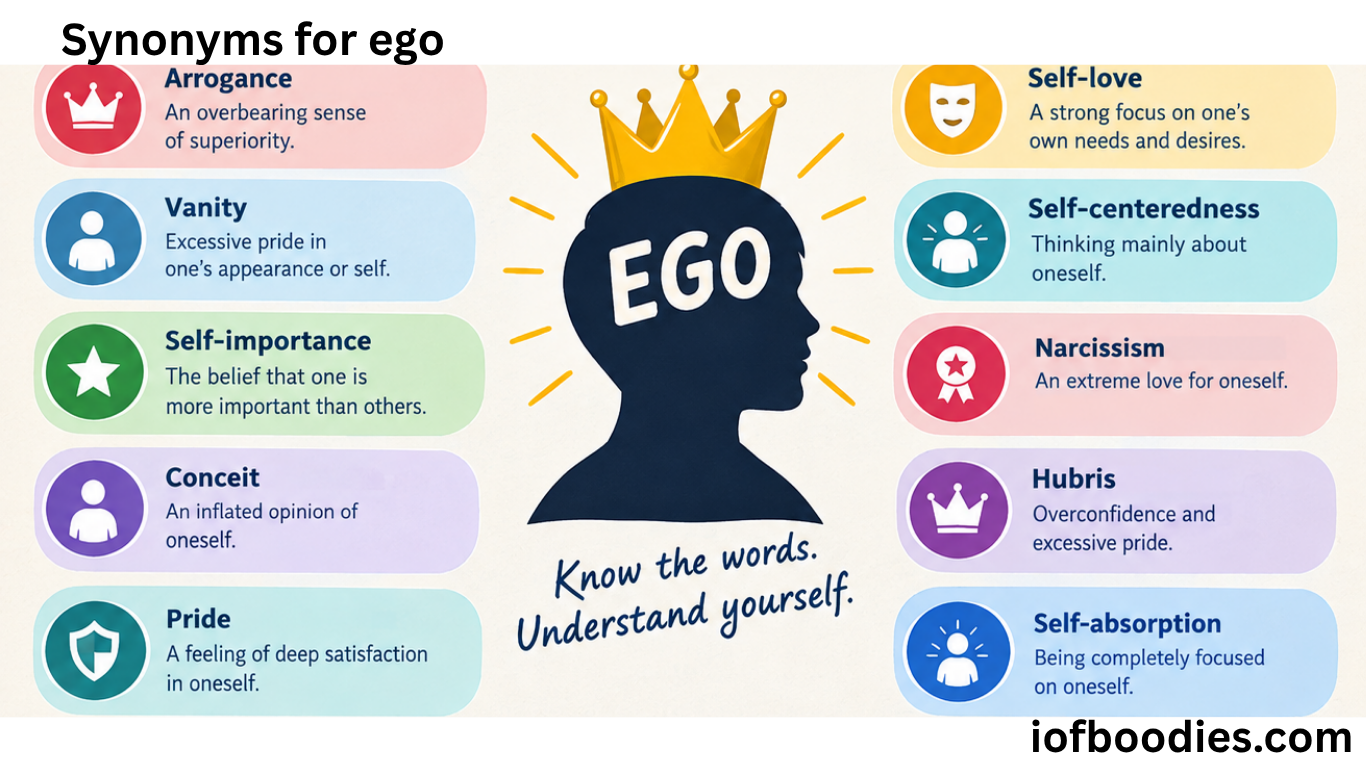
Synonyms for Ego: 40 Powerful Alternatives for Clearer Writing
The word ego describes how a person sees themselves, values their identity, and responds to their own importance. Depending on the situation, it can refer to healthy self-confidence, personal pride, or an exaggerated sense of superiority. Choosing the right synonym helps make your writing more accurate and expressive.
For example, a person who believes in their abilities may have strong self-confidence. Someone who constantly demands attention may show vanity or self-importance. Although these behaviors can sometimes look similar, they do not communicate the same meaning.
Writers, students, professionals, and English learners can use different alternatives to describe these shades of meaning. This guide explores 40 useful synonyms for ego, explains how they differ, and provides original examples to help you use them naturally.
What Does Ego Mean?
Ego is a noun that generally refers to a person’s sense of self. It can include how someone understands their identity, evaluates their abilities, and thinks about their importance in relation to other people.
In everyday English, ego often describes the way a person protects their pride or responds to criticism. Someone might say, “His ego was hurt when his idea was rejected.” This means the rejection affected his feelings about himself.
The word can also have a negative meaning. When a person believes they are more important or capable than everyone else, people may describe that person’s ego as inflated. However, ego is not always negative. A healthy sense of self can support confidence, independence, and personal boundaries.
40 Synonyms for Ego
The best synonym depends on the meaning you want to express. Some alternatives focus on confidence and self-respect, while others describe pride, self-centered behavior, or an exaggerated opinion of oneself.
1. Self-Image
Self-image is the mental picture a person has of themselves, including their strengths, weaknesses, appearance, and personality. It is useful when discussing how someone views their own character.

Example: Her self-image improved after she recognized her progress.
2. Self-Confidence
Self-confidence means trusting your abilities and feeling capable of handling situations. Unlike an inflated ego, confidence does not require someone to feel superior to others.
Also read:Synonyms for Lens: 33 Alternatives With Meanings and Examples
Example: His self-confidence helped him speak clearly during the interview.
3. Self-Esteem
Self-esteem describes how much a person values and respects themselves. It is especially useful in conversations about emotional well-being, personal growth, and relationships.
Example: Supportive feedback helped the student develop stronger self-esteem.
4. Self-Worth
Self-worth refers to the belief that you have value as a person. It emphasizes personal value rather than status, achievements, or other people’s approval.
Example: She learned that her self-worth did not depend on her job title.
5. Self-Respect
Self-respect means treating yourself with dignity and maintaining reasonable personal boundaries. It is a useful alternative when ego relates to refusing to accept disrespect.
Example: He showed self-respect by calmly explaining his boundaries.
6. Self-Regard
Self-regard describes the opinion or attitude a person has toward themselves. Depending on the context, it can suggest healthy respect or excessive concern about personal importance.
Example: Her self-regard remained steady even after a difficult review.
7. Self-Importance
Self-importance is the belief that your opinions, needs, or position matter more than those of other people. It is usually negative and often suggests an exaggerated sense of personal significance.
Example: His self-importance made ordinary team discussions difficult.
8. Arrogance
Arrogance is an exaggerated belief in one’s own abilities or importance, often accompanied by disrespect toward others. It is one of the clearest alternatives when ego means superiority.
Example: The manager’s arrogance prevented him from listening to useful advice.
9. Conceit
Conceit means having an excessively favorable opinion of yourself, especially your appearance, intelligence, or talents. It often suggests that a person admires themselves too much.
Example: His conceit became obvious when he dismissed every other person’s achievement.
10. Vanity
Vanity is excessive pride in one’s appearance, accomplishments, or qualities. It can describe a strong desire for admiration or attention.
Example: Her vanity led her to focus more on praise than on the quality of her work.
11. Pride
Pride can mean satisfaction in your efforts, identity, or achievements. It can also describe an unwillingness to admit mistakes or accept help.
Example: His pride made it difficult for him to apologize.
12. Self-Admiration
Self-admiration means feeling unusually pleased with your own qualities or achievements. It becomes a useful synonym when ego involves repeatedly praising oneself.
Example: His constant self-admiration left little room for other people’s contributions.
13. Egotism
Egotism is excessive interest in oneself and one’s own importance. An egotistical person may regularly direct conversations toward personal achievements or opinions.
Example: Her egotism turned a group celebration into a discussion about her success.
14. Self-Centeredness
Self-centeredness means concentrating mainly on your own feelings, needs, or interests without giving enough attention to others.
Example: His self-centeredness made it hard for him to understand his friend’s concerns.
15. Self-Absorption
Self-absorption describes being so focused on your own thoughts or experiences that you pay little attention to what is happening around you.
Example: Her self-absorption caused her to miss several important details in the conversation.
16. Narcissism
Narcissism can refer to excessive self-focus, a strong need for admiration, or an exaggerated sense of importance. In psychology, narcissistic traits and narcissistic personality disorder are not interchangeable terms.
Example: The article examined how narcissism can affect personal relationships.
17. Hubris
Hubris is excessive pride or confidence that causes someone to underestimate risks or believe they cannot fail. It is common in literary analysis, history, and discussions of leadership.
Example: The founder’s hubris led him to ignore warnings from experienced advisers.
18. Grandiosity
Grandiosity describes an exaggerated view of one’s importance, abilities, achievements, or influence. It is often used in formal, psychological, or analytical writing.
Example: His grandiosity was evident in the unrealistic claims he made about his influence.
19. Superiority
Superiority refers to being better than something else, but when discussing ego, it often means believing you are better than other people.
Example: She rejected the idea that professional success gave anyone a sense of superiority.
20. Overconfidence
Overconfidence means having more confidence in your judgment or abilities than the available evidence supports. It can lead to careless decisions.
Example: Overconfidence caused the team to underestimate the time required for the project.
21. Self-Assurance
Self-assurance is a calm belief in your abilities and judgment. It is generally positive and often suggests confidence without unnecessary boasting.
Example: He answered the difficult questions with self-assurance.
22. Self-Belief
Self-belief means trusting your potential and believing you can make progress toward your goals. It is particularly useful in motivational and personal-development writing.
Example: Her self-belief encouraged her to apply for a more challenging role.
23. Boldness
Boldness is the willingness to act confidently, take risks, or express an opinion. It can be positive when supported by good judgment.
Example: His boldness helped him raise an important concern during the meeting.
24. Swagger
Swagger describes a highly confident way of behaving or moving, often intended to attract attention or communicate status. Depending on the context, it can sound admiring or critical.
Also read:Synonyms for Assert: 40 Alternatives With Meanings and Examples
Example: He entered the room with a swagger that made his colleagues smile.
25. Bravado
Bravado is a display of confidence or courage that may hide fear or uncertainty. It is often used when someone’s outward behavior seems stronger than their actual feelings.
Example: His bravado disappeared when he had to answer the difficult questions.
26. Self-Concept
Self-concept is the collection of beliefs a person has about who they are. It can include identity, abilities, social roles, values, and personality.
Example: Moving to a new city changed her self-concept and her career goals.
27. Identity
Identity refers to the qualities, experiences, relationships, and values that help define a person. It is a broader and more neutral alternative to ego.
Example: His cultural identity played an important role in how he understood himself.
28. Self-Identity
Self-identity describes how someone understands and defines who they are. It is useful when discussing personal development, values, and changing life experiences.
Example: Volunteering helped her develop a stronger sense of self-identity.
29. Self-Perception
Self-perception is the way a person interprets their own behavior, characteristics, and abilities. It may differ from how other people see them.
Example: His self-perception changed after he received honest feedback from his team.
30. Self-View
Self-view is a person’s overall opinion of themselves. It is a straightforward expression for writing about confidence, personal beliefs, and self-evaluation.
Example: Her self-view became more positive as she gained experience.
31. Self-Awareness
Self-awareness means understanding your emotions, habits, motivations, strengths, and weaknesses. It can help people recognize when pride or insecurity affects their behavior.
Example: Greater self-awareness helped him accept criticism without becoming defensive.
32. Self-Consciousness
Self-consciousness can mean awareness of yourself, but in everyday conversation it often refers to feeling uncomfortable because you believe others are judging you.
Example: She felt self-conscious when she had to speak in front of a large audience.
33. Self-Focus
Self-focus means directing attention toward your own thoughts, feelings, goals, or needs. It can be useful for reflection but may become unhelpful when other people are consistently ignored.
Example: A period of self-focus helped him decide what he wanted from his career.
34. Self-Interest
Self-interest refers to concern for your own needs, benefits, or goals. It is not automatically selfish, although it can become problematic when it consistently harms others.
Example: The decision reflected personal self-interest rather than the needs of the whole team.
35. Egoism
Egoism is a term used in philosophy and ethics for views that place personal interest at the center of motivation or moral reasoning. In everyday usage, it can also suggest excessive concern for oneself.
Example: The class discussed whether egoism can explain people’s everyday decisions.
36. Inflated Ego
An inflated ego is an exaggerated sense of personal importance or ability. The phrase is common in everyday English and usually has a negative meaning.
Example: Winning a few awards gave him an inflated ego.
37. Big-Headedness
Big-headedness is an informal term for acting as though you are more talented or important than other people. It often describes someone who becomes boastful after success.
Example: His friends teased him about his big-headedness after the competition.
38. Self-Love
Self-love means caring for yourself and treating yourself with kindness and respect. It can overlap with a healthy ego, but it does not necessarily mean being self-centered.
Example: Practicing self-love helped her stop measuring her value through constant approval.
39. Modesty
Modesty means avoiding excessive attention to your achievements or importance. It is not a direct synonym for ego, but it can describe the opposite of an exaggerated ego.
Example: Despite receiving the award, he spoke about his team’s work with modesty.
40. Humility
Humility is the ability to recognize your strengths and limitations without treating yourself as superior to others. It can help balance confidence with openness to learning.
Example: Her humility made her willing to learn from employees with less experience.
Synonyms for Ego by Tone and Meaning
Not every synonym fits every sentence. The tone of a word can change how readers understand a person’s behavior.
Positive Alternatives
Self-confidence, self-esteem, self-worth, self-respect, self-assurance, and self-belief are useful when ego refers to a healthy sense of personal value. These terms are suitable for personal development, workplace communication, education, and discussions about emotional growth.
For example, “He developed self-confidence through practice” presents confidence as a helpful quality. Replacing self-confidence with arrogance would change the meaning and suggest an unpleasant attitude.
Neutral Alternatives
Self-image, self-concept, identity, self-perception, and self-view describe how people understand themselves. These expressions work well in academic writing, psychology discussions, and general explanations because they do not automatically suggest that a person is good or bad.
For example, “Her self-image changed after graduation” describes a change in how she viewed herself without judging that change.
Negative Alternatives
Arrogance, conceit, vanity, egotism, self-importance, and hubris are appropriate when ego suggests excessive pride or a belief in personal superiority. These words are more critical than neutral terms such as identity or self-concept.
For example, “His arrogance damaged the working relationship” clearly communicates a negative judgment about his behavior.
Ego vs. Pride vs. Arrogance
Ego, pride, and arrogance are related words, but they have different meanings.
| Word | Main meaning | Usual tone | Example |
| Ego | A person’s sense of self or importance | Neutral or negative | His ego was affected by the criticism. |
| Pride | Satisfaction in yourself or your achievements | Positive or negative | She felt pride in her work. |
| Arrogance | An exaggerated belief in your superiority | Negative | His arrogance stopped him from listening. |
| Self-esteem | The value you place on yourself | Usually positive or neutral | Her self-esteem improved over time. |
| Vanity | Excessive pride in appearance or qualities | Negative | Vanity influenced his choices. |
| Humility | Recognizing your value without claiming superiority | Positive | Humility helped her learn from mistakes. |
The important difference is that ego is a broad term. Pride can describe healthy satisfaction or stubbornness, while arrogance specifically suggests an attitude of superiority.
Also read:Synonyms for Draft: 50+ Words, Meanings, and Examples ✍️
How to Use Ego Synonyms in Different Situations
In Everyday Conversation
Everyday conversation usually benefits from familiar words such as confidence, pride, arrogance, and big-headedness. These words communicate feelings and behavior without requiring technical explanations.
For example, “Don’t let your pride stop you from apologizing” sounds natural in casual speech. “Don’t let your grandiosity stop you from apologizing” sounds more formal and may be inappropriate for an ordinary conversation.
In Professional Writing
Professional writing often requires precise language. Self-assurance can describe a confident employee, self-importance can describe someone who dominates meetings, and humility can describe a leader who recognizes other people’s contributions.
For example, “The candidate demonstrated self-assurance during the interview” is more specific and constructive than “The candidate had a strong ego.”
In Academic Writing
Academic writing may use self-concept, self-perception, egoism, or narcissism, depending on the subject. These terms are not interchangeable, so the writer should select the one that matches the concept being discussed.
For example, a discussion of personal identity may use self-concept, while an ethics paper about motivation may use egoism. A psychological discussion of narcissism should also distinguish general traits from a clinical diagnosis.
In Creative Writing
Creative writing can use expressive words such as swagger, bravado, conceit, and hubris to reveal a character’s personality. The best choice depends on whether the character is genuinely confident, hiding insecurity, or acting superior.
For example, “His bravado filled the room, but his hands trembled” suggests that the character’s confident appearance hides nervousness. The word provides information about both his behavior and his emotions.
Common Mistakes When Choosing an Ego Synonym
Treating Every Form of Ego as Negative
Ego does not always mean arrogance. It can refer to a person’s basic sense of self or their confidence in their own abilities. Use a negative synonym only when the context supports that meaning.
Confusing Confidence With Superiority
Confidence means trusting your abilities. Superiority, in the context of ego, means believing you are better than others. A confident person may respect other people’s skills, while an arrogant person may dismiss them.
Using Narcissism as a Casual Diagnosis
Calling someone narcissistic can imply more than ordinary selfishness or vanity. In clinical contexts, narcissistic personality disorder is a specific mental health diagnosis that requires professional assessment. For ordinary behavior, words such as self-centeredness or arrogance may be more accurate.
Choosing Formal Words for Casual Situations
Words such as grandiosity, egoism, and self-concept may sound unnatural in simple conversation. Use common alternatives when they express your meaning clearly. Formal vocabulary is most effective when it adds precision rather than unnecessary complexity.
Assuming Modesty Means Low Self-Worth
Modesty and low self-esteem are not the same. A modest person may recognize their abilities without boasting about them. A person with low self-esteem, by contrast, may struggle to recognize their own value.
Real-Life Examples of Ego and Its Alternatives
At Work
Imagine a team member who believes every successful project happened because of their personal effort. The word self-importance may describe this attitude, while egotism may emphasize their excessive focus on themselves.
If another employee speaks confidently but gives credit to the whole team, self-assurance is a better description. This example shows why context matters when choosing an alternative.
In Friendships
A person who refuses to apologize because they do not want to appear wrong may be acting out of pride. If they regularly dismiss friends’ feelings and insist on being the center of attention, self-centeredness may be more accurate.
Using the right word helps explain the behavior without treating every disagreement as a sign of arrogance.
In Personal Development
Someone who constantly doubts their abilities may benefit from building self-confidence and self-worth. Their challenge is not necessarily an oversized ego; it may be a lack of trust in themselves.
Another person may have confidence but struggle to accept advice. In that case, self-awareness and humility may help them recognize their limitations while keeping their strengths.
How to Choose the Best Synonym for Ego
Start by identifying what the word ego means in your sentence. If you mean a person’s value or respect for themselves, consider self-esteem, self-worth, or self-respect. If you mean their belief in their abilities, self-confidence or self-assurance may fit.
If the sentence describes excessive pride, consider arrogance, conceit, vanity, or self-importance. For a formal discussion of identity, self-concept or self-perception may be more accurate. For a character who appears brave but is hiding fear, bravado may communicate the idea more clearly.
Read the sentence again after replacing ego. The best synonym should preserve the intended meaning, tone, and level of formality.
Final Thoughts
Ego has several meanings, so no single synonym works in every situation. Words such as self-confidence, self-esteem, and self-respect can describe a healthy sense of personal value. Arrogance, vanity, and self-importance describe more negative attitudes, while identity and self-concept focus on how people understand themselves.
The most effective word is the one that expresses your intended meaning accurately. Understanding these differences can make everyday communication, academic writing, professional documents, and creative work clearer and more natural.
Frequently Asked Questions
What is the closest synonym for ego?
The closest synonym depends on the context. Self-image or self-concept may fit when ego means a person’s sense of self. Self-importance or arrogance may fit when it describes an exaggerated belief in personal importance.
What is a positive word for ego?
Self-confidence, self-esteem, self-worth, and self-assurance are positive alternatives when ego refers to a healthy sense of personal value. These words do not automatically suggest that someone considers themselves better than others.
What is a negative synonym for ego?
Arrogance, conceit, vanity, egotism, and self-importance are common negative alternatives. Each describes a slightly different form of excessive pride or self-focus.
Is ego the same as confidence?
No. Ego refers broadly to a person’s sense of self or personal importance, while confidence means trusting your abilities or judgment. Confidence can be healthy without involving arrogance or superiority.
What is the opposite of ego?
There is no single exact opposite because ego has several meanings. Humility and modesty can express the opposite of an inflated ego, while selflessness may contrast with excessive self-centeredness. A healthy sense of self does not need to disappear for someone to become humble.