Synonyms for Assert: 40 Alternatives With Meanings and Examples
The word “assert” is useful when you want to express an idea confidently, state something as true, or make your position clear. However, using the same word repeatedly can make your writing sound less natural. Learning synonyms for assert can help you communicate more clearly in essays, professional emails, academic writing, conversations, and everyday situations.
Some words similar to assert express confidence, while others emphasize a firm opinion, a factual statement, or the defense of a right. For example, “claim” may suggest that someone believes something is true, while “insist” shows strong determination. “Declare” often sounds formal, and “affirm” can suggest support or confirmation.
The best synonym depends on what you want to say and how strongly you want to say it. This guide explains 40 alternatives to assert, including their meanings, example sentences, differences in tone, and common uses.
What Does “Synonyms for Assert” Really Mean?
Synonyms for assert are words or expressions that can replace “assert” in certain situations without changing the main meaning of a sentence. The verb “assert” generally means to state something confidently, present an idea as true, or make your rights and opinions known.
For example, consider this sentence: “The researcher asserted that the results were accurate.” You could rewrite it as “The researcher maintained that the results were accurate.” Both sentences communicate that the researcher confidently supported the statement.
However, synonyms are not always interchangeable. “Announce” usually involves sharing information publicly, while “argue” involves giving reasons to support a position. “Emphasize” means giving special importance to a point, and “prove” means demonstrating that something is true with sufficient evidence. These words may work in some contexts but not in every sentence containing assert.
Understanding these differences helps you choose a word that fits your meaning, tone, and audience.
40 Synonyms for Assert With Meanings and Examples
The following words and expressions offer different ways to communicate an idea confidently. Each synonym includes a simple definition and an original example sentence to help you understand how it works.
1. Claim
Meaning: To state that something is true, especially when it has not yet been proven.
Example: The company claims that its new product reduces energy use.
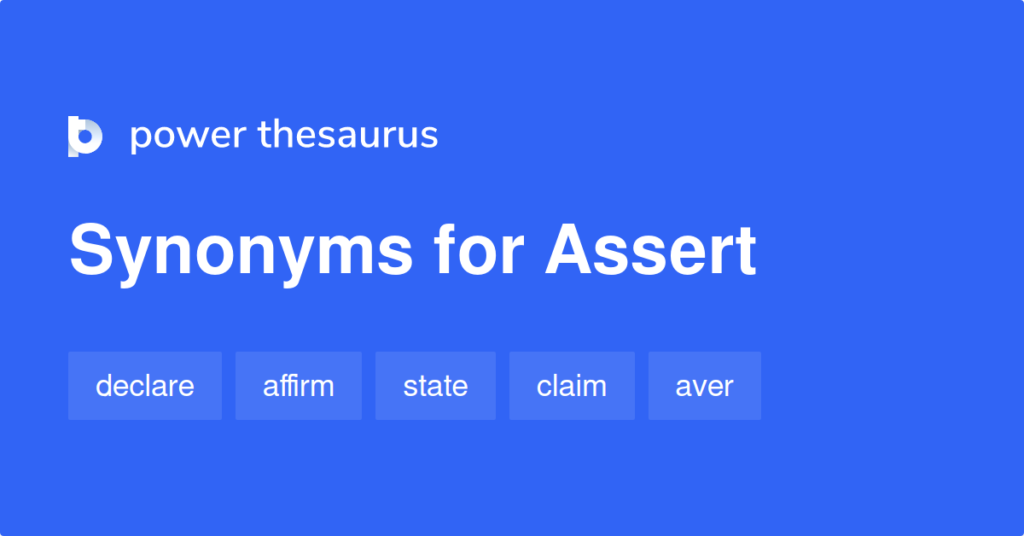
“Claim” is one of the closest synonyms for assert. It is common in everyday conversations, news reports, academic writing, and legal discussions. Unlike assert, it can sometimes suggest that a statement needs further evidence.
2. State
Meaning: To express information, an opinion, or a fact clearly.
Also read:Synonyms for Draft: 50+ Words, Meanings, and Examples ✍️
Example: The report states that the project was completed on time.
“State” is a neutral and professional alternative. It is useful when you want to communicate information without emphasizing confidence, disagreement, or emotional intensity.
3. Declare
Meaning: To announce or state something clearly and firmly.
Example: The mayor declared that public safety would remain a priority.
“Declare” often sounds more formal or official than assert. It is appropriate for public announcements, formal decisions, personal commitments, and strong statements of belief.
4. Affirm
Meaning: To confirm that something is true or express strong support for an idea.
Example: The witness affirmed that she had seen the vehicle.
“Affirm” is especially useful when confirming information or supporting a position. It often sounds reassuring, formal, or positive.
5. Maintain
Meaning: To continue saying that something is true, even when others disagree.
Example: The scientist maintains that more research is necessary.
“Maintain” works well when a person continues to support an opinion or explanation. It is particularly useful in debates, reports, academic discussions, and disagreements.
6. Insist
Meaning: To state something firmly and refuse to give up the position easily.
Example: Daniel insisted that the meeting begin on time.
“Insist” expresses determination more strongly than a neutral verb such as state. It can be useful when someone repeatedly emphasizes a point, although it may sound forceful or demanding.
7. Assertively Express
Meaning: To communicate an opinion or position confidently and directly.
Example: She expressed her concerns assertively during the team meeting.
This expression is useful when discussing communication style. It emphasizes confidence and clarity rather than simply stating whether a claim is true.
8. Contend
Meaning: To argue or maintain that something is true, especially in a disagreement or formal discussion.
Example: The lawyer contended that the evidence supported his client’s position.
“Contend” is common in academic writing, legal discussions, and formal arguments. It suggests that a person is presenting or defending a particular viewpoint.
9. Argue
Meaning: To give reasons for supporting an idea or position.
Example: The author argues that public transportation should receive more funding.
“Argue” is appropriate when someone supports a claim with reasoning. Unlike assert, it usually places more emphasis on the reasons behind a position rather than the act of stating it.
10. Confirm
Meaning: To establish that information is correct or that something is true.
Example: The manager confirmed that the application had been received.
“Confirm” is useful when information has been checked or verified. It is not always a direct synonym for assert because confirmation usually involves supporting an existing statement or expectation.
11. Emphasize
Meaning: To give special importance or attention to a particular point.
Example: The teacher emphasized the importance of reading every instruction carefully.
“Emphasize” works when the purpose is to highlight an idea. It does not necessarily mean that the speaker is claiming something is true; instead, it focuses attention on its importance.
12. Declare Firmly
Meaning: To communicate a position with confidence and determination.
Example: The captain declared firmly that the team would continue practicing.
This expression is useful when you want to show both the act of declaring and the strength of the speaker’s position. In formal writing, “declare” alone may be enough.
13. Proclaim
Meaning: To announce something publicly or express it in a strong, noticeable way.
Example: The organization proclaimed its commitment to protecting local wildlife.
“Proclaim” often has a public, formal, or dramatic tone. It is useful for statements about beliefs, commitments, achievements, and important announcements.
14. Avow
Meaning: To openly acknowledge or declare a belief, feeling, or position.
Example: He avowed his support for the community project.
“Avow” is a formal word that often relates to personal beliefs, loyalties, or commitments. It is less common in everyday conversation than claim or state.
15. Profess
Meaning: To openly express a belief, feeling, or opinion.
Example: She professed confidence in the new team’s abilities.
“Profess” can be used when someone openly expresses a belief or feeling. Depending on the context, it may simply describe a statement or suggest that the speaker’s sincerity is being questioned.
16. Uphold
Meaning: To support, defend, or maintain a principle, decision, or standard.
Example: The judge upheld the original decision.
“Uphold” is useful when someone supports a rule, decision, value, or principle. It is not a direct replacement for assert in every sentence because it focuses on maintaining or defending something rather than stating it.
17. Defend
Meaning: To support a person, idea, decision, or position against criticism or opposition.
Example: The manager defended the team’s decision to change the schedule.
“Defend” is a strong alternative when someone responds to criticism or challenges. It suggests active support rather than simply making a statement.
18. Advocate
Meaning: To publicly support or recommend an idea, policy, or cause.
Example: The group advocates better access to public libraries.
“Advocate” is especially appropriate when a person actively supports a cause or encourages others to accept an idea. It is common in professional, political, educational, and social discussions.
19. Assert One’s Rights
Meaning: To make one’s rights known and take steps to protect or exercise them.
Example: Employees should feel comfortable asserting their rights in the workplace.
This expression is often used in legal, workplace, and personal situations. It refers to expressing or protecting one’s rights, rather than merely claiming that a statement is true.
20. Express
Meaning: To communicate a thought, feeling, opinion, or idea.
Example: The student expressed her opinion respectfully during the discussion.
“Express” is a broad, natural alternative when the focus is on communicating an idea. It is less forceful than assert and may be preferable when you want a neutral tone.
21. Voice
Meaning: To express an opinion, concern, or feeling openly.
Example: Several residents voiced concerns about the proposed road.
“Voice” is especially useful when someone makes an opinion or concern known to others. It often appears in workplace, community, and public discussions.
22. Present
Meaning: To introduce information, an argument, or an idea for consideration.
Example: The researcher presented her argument at the conference.
“Present” is a good choice when someone formally introduces an argument or explanation. It focuses on how information is communicated rather than how firmly it is asserted.
23. Put Forward
Meaning: To suggest or introduce an idea, proposal, or argument.
Example: The committee put forward a new plan for improving public services.
“Put forward” is a natural expression in meetings, academic discussions, and planning. It is generally less forceful than assert because the idea is being introduced for consideration.
24. Propose
Meaning: To suggest a plan, idea, or course of action for others to consider.
Example: The team proposed a simpler method for organizing the files.
“Propose” is useful when assert refers to introducing a recommendation or possible solution. It does not usually mean that the speaker is declaring something to be unquestionably true.
25. Specify
Meaning: To state something clearly and exactly.
Example: The instructions specify which documents applicants must provide.
“Specify” is appropriate when a statement needs precise details. It is common in technical writing, policies, contracts, instructions, and professional communication.
26. Stipulate
Meaning: To state a specific requirement, condition, or fact, often formally.
Example: The agreement stipulates that payment must be completed within thirty days.
“Stipulate” is particularly useful in legal, contractual, and formal settings. It is more specific than assert because it often concerns a condition or requirement.
27. Testify
Meaning: To give evidence or make a statement, especially in a legal proceeding.
Example: The witness testified that the lights were off when she arrived.
“Testify” is a suitable alternative when assert describes a statement made under oath or as evidence. It should not replace assert in ordinary situations that have no connection to testimony.
28. Allege
Meaning: To claim that something happened or is true, especially when it has not been established.
Example: The complaint alleges that the company failed to follow its own policy.
“Allege” is common in legal reporting and formal investigations. It is important because it does not mean that a claim has been proven. Use it when the statement remains an allegation.
29. Purport
Meaning: To claim or appear to be something, often when the claim may be doubtful.
Example: The document purports to explain the origin of the unusual symbol.
“Purport” is useful when describing what a document, statement, or person claims to represent. It can suggest uncertainty about whether the claim is accurate.
30. Profess Confidence
Meaning: To openly state that one has confidence in a person, idea, or outcome.
Example: The director professed confidence in the revised strategy.
This expression works when the subject of the assertion is confidence or belief. It is more specific than assert and should be used only when it matches the intended meaning.
31. Reaffirm
Meaning: To state again that a belief, decision, or commitment remains true.
Example: The school reaffirmed its commitment to student safety.
“Reaffirm” is helpful when someone repeats or strengthens a position they have already expressed. It often appears in official statements, organizational communication, and public commitments.
32. Reiterate
Meaning: To repeat a statement or point for clarity or emphasis.
Example: The supervisor reiterated that all reports must be submitted by Friday.
“Reiterate” is appropriate when a speaker repeats an earlier statement. It is not exactly the same as assert because repetition, rather than confidence, is its main focus.
33. Insist Upon
Meaning: To firmly demand or maintain that something must happen or be accepted.
Example: The customer insisted upon receiving a written explanation.
“Insist upon” is useful when the statement concerns a demand, requirement, or firm expectation. It usually sounds stronger than simply expressing a preference.
34. Make the Case
Meaning: To provide reasons or evidence in support of an idea or position.
Example: The analyst made the case for investing in renewable energy.
This expression is common in persuasive writing, meetings, and debates. It emphasizes the reasoning used to support a position rather than just stating the position.
35. Stand By
Meaning: To continue supporting a statement or decision despite criticism.
Example: The author stood by her original explanation after the review.
“Stand by” works when someone refuses to withdraw a previous statement or decision. It emphasizes continued support, not necessarily the original act of asserting something.
36. Declare One’s Position
Meaning: To clearly communicate one’s opinion, decision, or stance.
Example: The candidate declared her position on education funding.
This expression is useful in debates, public discussions, workplace decisions, and personal disagreements. It focuses on making a person’s position clear to others.
37. Maintain That
Meaning: To continue to say that a particular statement is true.
Example: The researchers maintain that the findings need further testing.
“Maintain that” is especially natural in academic writing and discussions where people hold different interpretations. It indicates that the speaker continues to support a particular claim.
38. State Categorically
Meaning: To state something in a definite and unqualified way.
Example: The spokesperson stated categorically that the office would remain open.
This expression emphasizes certainty. It is best reserved for contexts where the speaker wants to remove doubt about what is being stated.
39. Assert Control
Meaning: To take or demonstrate control over a situation, process, or group.
Example: The new supervisor asserted control over the project schedule.
This phrase is useful when assert refers to exercising authority rather than stating a fact. It can sound forceful, so the surrounding context should make the intended meaning clear.
40. Make Clear
Meaning: To explain or communicate something so that others understand it.
Example: The teacher made clear that late assignments would need special approval.
“Make clear” is a natural alternative when the goal is to remove confusion or misunderstanding. It is less formal than assert and often sounds more direct and accessible.
Best Synonyms for Assert Based on Tone
The right synonym depends on the impression you want to create. Some alternatives sound neutral, while others suggest confidence, disagreement, formality, or persuasion.
Neutral Synonyms for Assert
“State,” “express,” “present,” and “make clear” are useful when you want to communicate information without sounding aggressive. These words fit everyday conversation, business emails, reports, and explanations.
Example: “The manager stated that the office would close early.”
This sentence communicates information directly without suggesting conflict or unusual certainty.
Strong Synonyms for Assert
“Insist,” “declare,” “affirm,” and “state categorically” can communicate greater certainty or determination. They are useful when the speaker wants to make a firm position clear.
Example: “The witness insisted that the account was accurate.”
The word “insisted” makes the statement sound stronger than “stated.”
Formal Synonyms for Assert
“Contend,” “stipulate,” “avow,” and “reaffirm” may be suitable for formal documents, academic writing, legal discussions, or official communication.
Example: “The report contends that the proposed changes would improve efficiency.”
These words help establish a formal tone, but they should be used only when their meanings fit the sentence.
Persuasive Synonyms for Assert
“Argue,” “advocate,” “make the case,” and “defend” work well when someone wants to convince others to accept a position.
Example: “The researcher argued that the policy required further review.”
These alternatives emphasize reasoning, support, or persuasion rather than simply making a statement.
Synonyms for Assertive
The adjective “assertive” describes someone who expresses thoughts, needs, or boundaries confidently and directly. It does not mean exactly the same thing as the verb “assert.”
Useful alternatives for assertive include “confident,” “direct,” “self-assured,” “decisive,” “forthright,” and “outspoken.”
Also read:Good Luck Synonyms: 40+ Fresh Ways to Wish Someone Success 🍀
For example, “She is assertive during meetings” could become “She is confident and direct during meetings.”
The best word depends on the intended tone. “Forthright” suggests openness and honesty, while “outspoken” can suggest that someone expresses opinions freely, even when others disagree.
Assert vs. Claim vs. Insist: What Is the Difference?
“Assert,” “claim,” and “insist” are closely related, but each word emphasizes something different.
| Word | Main meaning | Typical tone | Example |
| Assert | State something confidently | Firm or formal | He asserted that the figures were correct. |
| Claim | State that something is true | Neutral or sometimes doubtful | He claimed that the figures were correct. |
| Insist | State something firmly and persistently | Strong or determined | He insisted that the figures were correct. |
| State | Communicate information clearly | Neutral | He stated that the figures were correct. |
| Affirm | Confirm or support a statement | Formal or positive | He affirmed that the figures were correct. |
| Contend | Argue that something is true | Formal or argumentative | He contended that the figures were correct. |
The main difference is emphasis. “Assert” highlights a confident statement. “Claim” presents something as true without necessarily confirming it. “Insist” emphasizes determination, particularly when a person faces disagreement.
For example, if a person says, “I assert that the information is correct,” the statement sounds firm. If the person says, “I claim that the information is correct,” the sentence may sound more neutral or invite questions about the evidence. If the person says, “I insist that the information is correct,” the sentence suggests a stronger and more persistent position.
How to Use Assert in a Sentence
The verb “assert” usually takes a statement, belief, opinion, or clause as its object. It can also describe expressing authority or making a right known.
Assert as a Statement of Fact
Use assert when someone presents an idea or claim as true.
Example: The researcher asserted that the results were consistent with earlier findings.
This sentence means that the researcher confidently stated the results supported the earlier findings. It does not automatically prove that the statement is correct.
Assert an Opinion
Use assert when someone expresses a position confidently.
Example: Maya asserted that every student should have access to a library.
Here, assert communicates a firm opinion. If the sentence focused on giving reasons for the opinion, “argued” might be a better choice.
Assert Authority
Use assert authority when someone demonstrates or exercises their power, role, or control.
Example: The new director asserted her authority by clarifying the team’s responsibilities.
In this context, assert does not mean merely stating a fact. It refers to making authority clear through words or actions.
Assert One’s Rights
Use assert one’s rights when someone makes their rights known or takes steps to protect them.
Example: The tenant asserted his rights under the rental agreement.
This phrase is common in workplace, housing, legal, and personal situations. Its exact meaning depends on the relevant rules and circumstances.
Use Assertion in a Sentence
The noun “assertion” refers to a statement that someone presents as true.
Example: Her assertion that the road was closed surprised the entire team.
Another example is: “The report examined the assertion that the changes would reduce costs.”
In both sentences, assertion refers to a claim or statement, not the act of making the statement itself.
Assert: Definition, Part of Speech, and Related Words
Understanding the basic meaning of assert makes it easier to select synonyms and use related forms correctly.
Assert Definition
Assert is a verb meaning to state something confidently, present a statement as true, or make one’s authority, rights, or position known.
In simple English, to assert means to say something firmly or to stand up for a position.
Example: “He asserted that he had followed the instructions.”
Assert Part of Speech
“Assert” is a verb. Its common forms include “asserts,” “asserted,” and “asserting.”
“Assertion” is the related noun. “Assertive” and “assertive” communication are associated with expressing oneself confidently, while “assertiveness” is the noun describing that quality.
Examples include “She asserts her opinion,” “He asserted his position,” and “They are asserting their rights.”
Asserts Meaning
“Asserts” is the third-person singular present form of assert. It describes what one person or subject states confidently.
Example: “The author asserts that the method is effective.”
Asserted Meaning
“Asserted” is the past tense and past participle of assert. It describes a statement or position expressed in the past.
Example: “The witness asserted that the event occurred in the morning.”
Asserting Meaning
“Asserting” is the present participle of assert. It can describe the act of stating something confidently or making a position clear.
Example: “She is asserting her right to ask questions.”
Assertion Definition
An assertion is a statement that someone presents as true. An assertion may be supported by evidence, challenged by another person, or accepted after further examination.
Example: “The assertion needed additional evidence before the committee could accept it.”
Assertive Meaning
Assertive describes a person or communication style that expresses ideas, needs, opinions, or boundaries confidently and directly. Healthy assertiveness is different from aggression because it does not require disrespecting other people.
Example: “He used an assertive but respectful tone when discussing the problem.”
Synonyms for Assertion
The noun “assertion” has several alternatives, but the most appropriate one depends on the sentence.
“Claim” is useful for a statement presented as true. “Statement” is a neutral choice. “Declaration” suggests a clear or formal announcement. “Contention” often refers to a position maintained during an argument or debate. “Proposition” describes an idea or statement put forward for consideration.
For example, “Her assertion was difficult to verify” could become “Her claim was difficult to verify.”
However, “Her declaration was difficult to verify” may sound different because declaration often suggests a formal announcement. Choosing the right word helps preserve the original meaning.
Synonyms for Assertive and Assertiveness
Assertive and assertiveness are related to assert, but they describe a communication style or personal quality rather than a single statement.
“Confidence” emphasizes belief in oneself or one’s abilities. “Directness” means communicating clearly without unnecessary indirect language. “Self-assurance” suggests confidence in one’s judgment. “Forthrightness” emphasizes openness and honesty. “Decisiveness” refers to making decisions firmly.
For example, “Her assertiveness helped her explain her concerns” could be rewritten as “Her confidence helped her explain her concerns.” However, the meaning changes slightly because confidence does not always include direct communication or boundary-setting.
A negative synonym for assertive may include “aggressive,” “pushy,” “overbearing,” or “domineering,” depending on the context. These words should not be treated as exact synonyms because they usually suggest excessive force or disregard for others. Assertiveness itself is not necessarily negative.
Likewise, “passive,” “hesitant,” or “unassertive” may describe a lack of assertiveness, but they do not mean the same thing as assertive.
Antonyms of Assert
Antonyms are words with opposite or contrasting meanings. The opposite of assert depends on whether assert means stating a claim, defending a position, or exercising authority.
“Deny” is a useful antonym when someone rejects a statement or says something is not true. “Retract” means to withdraw a statement previously made. “Withdraw” can describe taking back a claim or position. “Disclaim” means to deny responsibility, ownership, or a connection in certain contexts.
For example, “She asserted that the report was accurate” could be contrasted with “She denied that the report was accurate.”
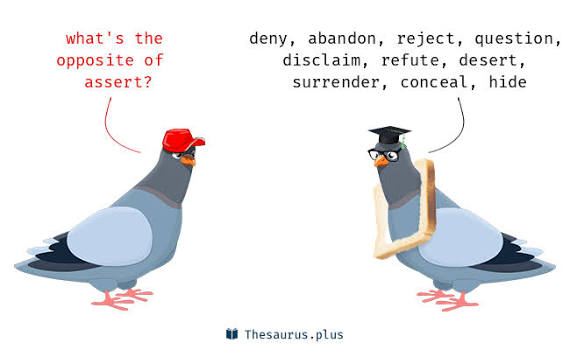
“Retract” works in a different situation: “She retracted her earlier statement after reviewing the evidence.”
When assert means exercising authority, possible contrasts include “yield,” “surrender,” or “relinquish,” depending on the sentence. There is no single antonym that works for every meaning of assert.
Common Mistakes When Choosing a Synonym for Assert
Using Claim When You Mean Prove
A claim is a statement presented as true, but it does not automatically establish that the statement is correct. If evidence demonstrates that something is true, “prove” or “confirm” may be more suitable.
Incorrect: “The results claimed that the treatment worked.”
Better: “The results indicated that the treatment worked.”
The revised sentence makes the results the source of the information without treating them as a person making a claim.
Using Insist in Every Situation
“Insist” suggests determination or persistence. It may make a neutral sentence sound argumentative.
Instead of writing “The report insisted that costs had increased,” write “The report stated that costs had increased.”
The second version is more natural because a report presents information rather than persistently demanding that readers accept it.
Also read:🏗️ Synonyms for Implemented: 30+ Powerful Alternatives, Meanings, and Examples
Confusing Assertive With Aggressive
Assertive communication is direct and confident. Aggressive communication can involve hostility, pressure, or disregard for others.
For example, a person who respectfully explains a boundary is being assertive. A person who threatens others to get their way may be acting aggressively.
This distinction is important when choosing synonyms for assertive, especially in workplace communication and personal relationships.
Treating Every Related Word as an Exact Synonym
Words such as “reveal,” “announce,” “prove,” and “defend” may overlap with assert in certain contexts, but their meanings differ.
“Reveal” means making information known. “Announce” means sharing information publicly or formally. “Prove” means demonstrating that a statement is true. “Defend” means supporting something against criticism or opposition.
Before replacing assert, consider what the original sentence is trying to communicate.
Real-Life Examples of Assert and Its Synonyms
In the Workplace
Original: “The supervisor asserted that the deadline could not be changed.”
Alternative: “The supervisor stated that the deadline could not be changed.”
Use “stated” if the supervisor is simply communicating a decision. Use “insisted” if the supervisor repeatedly emphasizes that the deadline must remain unchanged.
In Academic Writing
Original: “The author asserts that the policy has several limitations.”
Alternative: “The author argues that the policy has several limitations.”
Use “argues” when the author provides reasons to support the position. Use “contends” when you want a more formal tone.
In Everyday Conversation
Original: “She asserted that she had locked the door.”
Alternative: “She maintained that she had locked the door.”
“Maintained” is useful if she continues to support her statement despite questions or disagreement.
In Legal or Official Communication
Original: “The document asserts that the agreement was signed voluntarily.”
Alternative: “The document states that the agreement was signed voluntarily.”
“States” is more neutral. If the statement is an unproven allegation in a legal complaint, “alleges” may be more accurate.
In Personal Communication
Original: “He asserted his need for more personal time.”
Alternative: “He expressed his need for more personal time.”
“Expressed” sounds natural and less formal. If the focus is on setting a clear boundary, “asserted his boundaries” may be appropriate.
Practice Exercise: Choose the Best Synonym for Assert
Test your understanding with these short questions. Choose the word that best fits each sentence.
Question 1
The researcher ______ that the results required further investigation.
A. maintained
B. painted
C. borrowed
D. misplaced
Question 2
The witness ______ that she had seen the event.
A. testified
B. decorated
C. postponed
D. delivered
Question 3
The manager ______ the importance of meeting the deadline.
A. emphasized
B. ignored
C. concealed
D. abandoned
Question 4
The organization publicly ______ its support for the new community program.
A. proclaimed
B. erased
C. confused
D. postponed
Question 5
The employee respectfully ______ concerns about the new schedule.
A. voiced
B. removed
C. borrowed
D. misplaced
Answers and Explanations
Question 1: A. Maintained. The word fits because the researcher continues to support a particular position.
Question 2: A. Testified. This word is appropriate when a witness gives evidence or makes a formal statement.
Question 3: A. Emphasized. The sentence focuses on highlighting the importance of a deadline.
Question 4: A. Proclaimed. The organization is making its support publicly known.
Question 5: A. Voiced. The employee communicated concerns openly and directly.
Conclusion
Learning synonyms for assert helps you choose words that communicate confidence, certainty, support, or disagreement more precisely. “State” and “express” are useful for neutral communication, while “insist” and “declare” convey greater firmness. “Contend” and “argue” work well when someone supports a position, and “affirm” is useful when confirming a statement.
Remember that a synonym should fit the meaning of the entire sentence, not just replace a word mechanically. When writing an academic paper, professional email, report, or everyday message, consider whether you are stating a fact, defending an opinion, confirming information, or making your rights known. Choosing the right alternative will make your writing clearer, more natural, and more effective.
Frequently Asked Questions
What is the best synonym for assert?
“State,” “claim,” “declare,” “affirm,” and “maintain” are among the most useful synonyms for assert. The best choice depends on the context. Use “state” for neutral information, “claim” for a statement presented as true, “declare” for a firm or formal statement, and “maintain” when someone continues to support a position.
What does assert mean in simple English?
Assert means to say something confidently or make a position clear. It can also mean standing up for one’s rights or demonstrating authority. For example, “She asserted that the information was correct” means she confidently stated that the information was correct.
What is another word for asserting?
Another word for asserting may be “stating,” “claiming,” “declaring,” “affirming,” or “maintaining.” If someone is defending an opinion, “arguing” or “contending” may fit better. The best alternative depends on whether the person is stating a fact, expressing a belief, or supporting an argument.
What is the difference between assert and assertive?
“Assert” is a verb that describes stating something confidently or making a position known. “Assertive” is an adjective that describes someone who communicates confidently and directly. For example, “She asserted her opinion” describes an action, while “She is assertive” describes her communication style.
What are the antonyms of assert?
Common antonyms or contrasting words include “deny,” “retract,” “withdraw,” and “disclaim,” depending on the intended meaning. “Deny” means to reject a claim, while “retract” means to take back a statement. When assert refers to exercising authority, words such as “yield” or “relinquish” may provide a more appropriate contrast.