Concious or Conscious: Which Spelling Is Correct?
If you are wondering whether the correct spelling is “concious” or “conscious,” the answer is simple: conscious is the correct spelling.
“Concious” is a common spelling mistake. The confusion happens because the word contains a combination of letters that can be difficult to remember, especially the “sc” in the middle. Many people pronounce “conscious” in a way that makes the spelling less obvious, so forms such as “consious,” “conshious,” “consciouss,” and “conscous” may appear in informal writing or online searches.
Learning the correct spelling is useful because “conscious” is a common English word. It can describe being awake and aware, knowing about something, or deliberately thinking about an action or decision. The related noun “consciousness” refers to the state or quality of being aware.
This guide explains the difference between “concious” and “conscious,” why the mistake is common, how to remember the correct spelling, how to use the word in a sentence, and how related misspellings such as “concius,” “consius,” “concsious,” and “consciousnes” occur.
Concious or Conscious: The Correct Spelling
The correct spelling is conscious.
The incorrect spelling is concious.
| Spelling | Correct? | Example |
| conscious | Yes | She was conscious of the noise. |
| concious | No | This is a common misspelling. |
| consious | No | The “c” after “s” is missing. |
| conshious | No | This spelling follows the sound incorrectly. |
| consciouss | No | The ending has an extra “s.” |
| conscous | No | The “i” is missing. |
| concius | No | The spelling is missing important letters. |
| consius | No | This is another phonetic misspelling. |
| concsious | No | The letters are placed incorrectly. |
| consciousnes | No | The ending of “consciousness” is incomplete. |
The easiest answer to remember is:
Conscious = C-O-N-S-C-I-O-U-S
The word has “sci” in the middle:
con + sci + ous
This spelling pattern can help you avoid the common mistake “concious.”
What Does Conscious Mean?
“Conscious” is an adjective with several related meanings.
The most common meaning is being awake and aware rather than unconscious.
For example:
The patient was conscious after the accident.
In this sentence, “conscious” means the person was awake and able to be aware of what was happening.
The word can also mean being aware of something.
For example:
He was conscious of the people waiting behind him.
Here, “conscious of” means aware of or noticing something.
Another meaning is intentional or deliberate.
For example:
She made a conscious decision to save money.
In this example, the decision was made deliberately rather than accidentally.
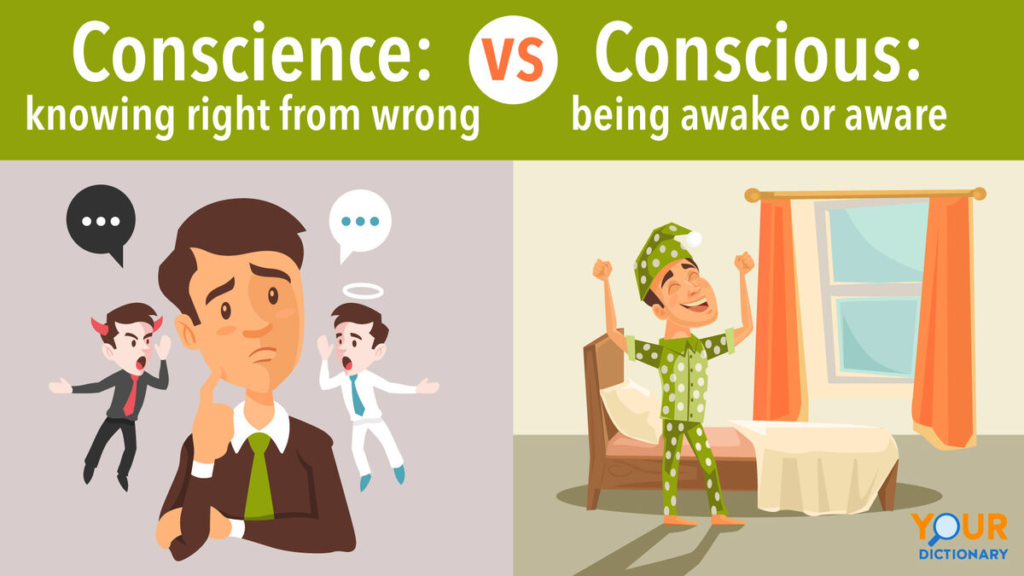
The word therefore has an important connection with awareness, attention, knowledge, intention, and consciousness.
What Does Concious Mean?
“Concious” does not have a standard meaning in modern English. It is generally a misspelling of “conscious.”
If you write:
I am concious of the problem.
the correct version is:
I am conscious of the problem.
The mistake is understandable because the word’s pronunciation does not make every letter easy to identify. However, “concious” should be avoided in school assignments, professional writing, emails, resumes, websites, and other formal communication.
Spell-checking tools may identify “concious” as an error and suggest “conscious.”
Why Do People Spell Conscious as Concious?
The spelling mistake “concious” is common because English spelling does not always closely match pronunciation.
When people say “conscious,” the middle of the word can sound similar to “shus” in ordinary speech. As a result, a writer may remember the pronunciation rather than the written form.
There is another problem: the sequence “sci” is easy to overlook.
The correct word is:
conscious
A person may remember it as:
concious
The difference is the letter “s” after the first “c.”
Also Read: Calendar or Calender: Which Spelling Is Correct?
Correct:
con-sci-ous
Incorrect:
con-ci-ous
This is why learning the word visually can be more helpful than relying only on pronunciation.
How to Spell Conscious Correctly
A useful way to spell “conscious” is to divide it into smaller parts:
con + sci + ous
Put those parts together:
conscious
You can also spell it letter by letter:
C-O-N-S-C-I-O-U-S
The important part to remember is:
SCI
Many people who write “concious” forget the second “s.”
A simple spelling check is:
Does the word contain “sci” after “con”?
If yes, you probably have the correct spelling:
con + sci + ous = conscious
A Simple Memory Trick for Conscious
One useful memory trick is:
Conscious has “SCI” in it.
You can connect “SCI” with the idea of science and awareness. This does not explain the historical origin of the word, but it can be a practical spelling reminder.
Another method is to remember:
con-SCI-ous
The “SCI” should stay together in the middle.
You can also associate “conscious” with “consciousness.” Once you know the spelling of the adjective, it becomes easier to recognize the related noun.
Conscious vs. Consciousness
“Conscious” and “consciousness” are closely related, but they are different parts of speech.
“Conscious” is an adjective.
Example:
She remained conscious throughout the procedure.
“Consciousness” is a noun.
Example:
Scientists study consciousness and awareness.
The adjective describes a person or state. The noun refers to the state or quality itself.
Conscious
Correct spelling:
conscious
Example:
He was conscious of his surroundings.
Consciousness
Correct spelling:
consciousness
Example:
Consciousness is a complex subject studied in philosophy and neuroscience.
A common mistake is writing “consciousnes.”
The correct ending is:
-ness
Therefore:
conscious + ness = consciousness
What Is Consciousness?
Consciousness is the state or quality of being aware of yourself, your surroundings, experiences, thoughts, sensations, or other mental activity.
The term is used in everyday language as well as in fields such as psychology, neuroscience, philosophy, medicine, and cognitive science.
For example, someone may say:
The patient regained consciousness.
In medicine, this generally means that the person returned to an awake and responsive state after being unconscious.
In philosophy and neuroscience, however, consciousness is a much broader and more complicated topic. Researchers continue to study how subjective experience relates to the brain and nervous system.
It is important to distinguish the everyday meaning from specialized scientific or philosophical discussions.
Conscious Meaning in Everyday English
In everyday American English, “conscious” is commonly used in three ways.
1. Awake and Responsive
The first meaning is being awake rather than unconscious.
Example:
The driver was conscious and able to answer questions.
2. Aware of Something
“Conscious of” can mean aware of, noticing, or understanding something.
Example:
She became conscious of the noise outside.
3. Deliberate or Intentional
“Conscious” can describe something done intentionally.
Example:
He made a conscious effort to arrive early.
These meanings are connected because they all involve awareness in some form.
Common Examples of Conscious in a Sentence
Here are several simple examples:
- I was conscious of the change in temperature.
- She remained conscious after the fall.
- He made a conscious effort to listen carefully.
- They were conscious of the deadline.
- The patient became conscious several minutes later.
- She is conscious of how her words affect others.
- He made a conscious choice to reduce unnecessary spending.
- The company is conscious of its environmental impact.
- I became conscious that everyone was waiting.
- She was conscious of the responsibility she had accepted.
These examples demonstrate the major everyday uses of the word.
Conscious of vs. Conscious About
“Conscious of” is a standard and very common construction.
For example:
I am conscious of my responsibilities.
It means:
I am aware of my responsibilities.
“Conscious about” can also occur in English, but it often has a different feeling. It may describe being worried, sensitive, or self-aware about something.
For example:
He is self-conscious about his appearance.
In many situations, “conscious of” is the clearer choice when you simply mean “aware of.”
Conscious vs. Aware
“Conscious” and “aware” are sometimes interchangeable, but they are not always identical.
“Aware” usually means knowing or noticing something.
Example:
She was aware of the problem.
“Conscious” can also mean aware:
She was conscious of the problem.
However, “conscious” can carry additional meanings, including being awake or making an intentional decision.
For example:
He was unconscious after the accident.
The opposite of “unconscious” in this medical or physical sense is “conscious.”
“Aware” does not work in exactly the same way in that context.
Conscious vs. Conscientious
Another word that sometimes causes confusion is “conscientious.”
The words “conscious” and “conscientious” look similar, but they have different meanings.
“Conscious” means aware or awake.
Example:
She was conscious of the risk.
“Conscientious” means careful, responsible, and attentive to doing something correctly.
Example:
He is a conscientious employee.
The spelling is also different:
conscious
conscientious
The two words are related historically, but they should not be treated as interchangeable.
Conscious vs. Self-Conscious
“Self-conscious” is a compound adjective formed from “self” and “conscious.”
It commonly describes someone who feels unusually aware of themselves, especially because they believe other people are noticing or judging them.
Example:
She felt self-conscious when she had to speak in front of a large audience.
“Conscious” by itself does not necessarily imply embarrassment or insecurity.
For example:
He was conscious of the time.
This simply means he was aware of the time.
Common Misspellings of Conscious
People may type several variations of “conscious” when they are unsure of the spelling.
Some common examples include:
Consious
“Consious” leaves out the second “c” in the middle.
Incorrect:
She was consious of the problem.
Correct:
She was conscious of the problem.
Conshious
“Conshious” is a phonetic attempt to represent the way the word can sound when spoken.
Correct:
conscious
Consciouss
“Consciouss” usually adds an unnecessary “s” at the end.
Correct:
conscious
Conscous
“Conscous” leaves out the “i.”
Correct:
conscious
Concius
“Concius” changes the internal letter sequence and removes letters from the correct spelling.
Correct:
conscious
Consius
“Consius” is another spelling based more on pronunciation than standard written English.
Correct:
conscious
Concsious
“Concsious” rearranges or adds letters in the middle of the word.
Correct:
conscious
Consciousnes
“Consciousnes” is a common type of incomplete spelling for the noun “consciousness.”
Correct:
consciousness
Understanding these variations can be useful because people may encounter them in search queries, informal posts, comments, messages, or drafts.
Why English Spelling Can Be Difficult
The “concious or conscious” question illustrates a broader problem in English: pronunciation and spelling do not always match perfectly.
English has developed from multiple linguistic sources, including Germanic languages, French, Latin, Greek, and others. As vocabulary entered the language at different periods, spelling patterns developed and changed over time.
As a result, English contains many words whose spellings cannot be predicted perfectly from pronunciation.
For example:
- receive
- separate
- necessary
- definitely
- pronunciation
- conscious
This is one reason memorization, repeated exposure, reading, and spell-checking can be helpful.
The Origin of the Word Conscious
The history of “conscious” helps explain why the spelling looks unusual.
The word ultimately traces back through French and Latin. It is related to the Latin word “conscius,” associated with knowing or being aware, particularly knowing something together or being aware of something.
Over time, related forms developed in European languages and eventually entered English.
The modern English spelling is:
conscious
Its historical development helps explain why the spelling does not simply follow the way the word sounds in modern American English.
Is Conscious a Noun, Verb, or Adjective?
“Conscious” is primarily an adjective.
Examples:
She is conscious.
He was conscious of the risk.
They made a conscious decision.
The related forms include:
- consciousness — noun
- consciously — adverb
- unconscious — adjective
- unconsciously — adverb
- conscientious — a related-looking but distinct adjective
Understanding word families can make spelling easier because you begin to recognize recurring patterns.
Conscious and Unconscious
“Unconscious” is formed by adding the prefix “un-” to “conscious.”
Conscious:
The person was conscious.
Unconscious:
The person was unconscious.
In everyday and medical contexts, “unconscious” commonly means not awake or not responsive.
In psychology and other fields, “unconscious” can have additional meanings involving mental processes outside ordinary awareness.
The exact meaning depends on context.
Conscious Meaning in Medical Contexts
In medical communication, “conscious” can describe a person’s level of wakefulness and responsiveness.
For example:
The patient was conscious and responding to questions.
Medical professionals may use more specific terms when describing a person’s neurological or mental status. “Conscious” alone does not provide a complete medical assessment.
It is therefore better to avoid assuming that someone who is conscious is necessarily fully alert, oriented, or medically stable. These concepts can be assessed separately.
This distinction is useful because everyday language often treats “conscious” and “fully alert” as identical, while clinical assessment can be more precise.
Conscious Meaning in Psychology
Psychology uses “conscious” to discuss thoughts, feelings, perceptions, attention, and experiences that are within a person’s awareness.
For example:
She became conscious of her negative thought pattern.
The field may also discuss unconscious or less accessible mental processes.
However, psychological terminology can vary between different theories and research traditions. A general dictionary definition should not be treated as a complete explanation of scientific theories about consciousness.
Conscious Meaning in Neuroscience
Neuroscience investigates how brain activity relates to perception, attention, wakefulness, and subjective experience.
Also Read: Beginning or Begining: Which Spelling Is Correct?
Consciousness remains a major area of scientific research because researchers are still working to understand exactly how physical processes in the brain relate to conscious experience.
Scientific discussions may distinguish between:
- wakefulness
- awareness
- attention
- perception
- self-awareness
- subjective experience
These concepts overlap but are not necessarily identical.
Consciousness in Philosophy
Consciousness has been discussed by philosophers for centuries.
Philosophical questions include:
- What does it mean to have subjective experience?
- How do we know that other people are conscious?
- What is the relationship between mind and body?
- Can consciousness be fully explained by physical processes?
- What makes an experience feel personal?
These questions are much broader than the spelling issue “concious or conscious,” but understanding the related word “consciousness” helps explain why the term is important across many fields.
How to Remember the Correct Spelling
If you frequently write “concious,” try one of these methods.
Remember “SCI”
Think:
con + SCI + ous
That gives:
conscious
Write It Repeatedly
Writing the word several times can help build visual familiarity:
conscious
conscious
conscious
conscious
Learn the Word Family
Remember:
conscious → consciousness → consciously
Seeing the same spelling pattern in related words can reinforce memory.
Use the Word in Sentences
Instead of memorizing the word alone, practice it in context:
I am conscious of the mistake.
She made a conscious choice.
He regained consciousness.
Context makes spelling easier to remember.
How to Check Whether You Spelled Conscious Correctly
When proofreading, look at the middle of the word.
Correct:
con-sci-ous
Incorrect:
con-ci-ous
If the “s” is missing after “con,” the word is probably misspelled.
Also remember that “conscious” ends with:
-ous
not:
-ouss
That helps prevent the spelling “consciouss.”
Concious or Conscious in American English
For readers in the United States, the standard spelling is:
conscious
American English and British English both use “conscious” as the standard spelling.
This is not a major American-versus-British spelling difference. Unlike words such as “color” and “colour,” “conscious” is spelled essentially the same in both major varieties of English.
Therefore, American writers should use “conscious” in school, workplace, business, academic, and everyday writing.
Concious or Conscious in School Writing
Students may encounter the word in essays, reading assignments, tests, and classroom discussions.
Using “conscious” correctly is important because spelling errors can affect the clarity and perceived quality of academic writing.
For example:
Incorrect:
The character became concious of the danger.
Correct:
The character became conscious of the danger.
A good proofreading habit is to use a dictionary or reliable spell-checking tool when a word does not look familiar.
Concious or Conscious in Professional Writing
Professional writing requires accuracy because small spelling mistakes can affect credibility.
The word “conscious” may appear in:
- business emails
- reports
- presentations
- resumes
- marketing materials
- workplace policies
- educational documents
- customer communications
For example:
We are conscious of the importance of protecting customer information.
Using the correct spelling makes the sentence appear polished and professional.
Concious or Conscious in Online Searches
People often search for a word in its incorrect form when they are unsure how to spell it.
Searches such as “concious or conscious,” “consious,” or “conshious” usually indicate a spelling question.
Search engines and autocorrect systems can often recognize the intended word and return results for “conscious.”
This does not make the misspelling acceptable in formal writing. Search behavior simply shows that spelling uncertainty is common.
From an SEO perspective, websites can address these queries naturally by explaining the correct spelling rather than repeatedly inserting misspellings into unrelated text.
Search Intent Behind “Concious or Conscious”
The search query “concious or conscious” has clear informational intent.
A person searching it usually wants to know:
- Which spelling is correct?
- What does the word mean?
- Why is the spelling difficult?
- How should the word be used?
- How can the spelling be remembered?
- What are related words such as “consciousness”?
A helpful article should answer these questions directly rather than simply stating that one spelling is correct.
This is especially important for educational SEO because users often want a quick answer followed by enough explanation to understand the rule.
Featured Snippet Answer: Concious or Conscious?
If you need the shortest possible answer:
“Conscious” is the correct spelling. “Concious” is a common misspelling. The correct spelling is C-O-N-S-C-I-O-U-S.
Example:
She was conscious of the problem.
People Also Ask: Is Concious a Word?
No. “Concious” is generally a misspelling of the standard English word “conscious.”
The correct spelling is:
conscious
People Also Ask: How Do You Spell Conscious?
Spell it:
C-O-N-S-C-I-O-U-S
A useful way to remember it is:
con + sci + ous
People Also Ask: What Is the Difference Between Conscious and Consciousness?
“Conscious” is an adjective describing a state of awareness, wakefulness, or deliberate thought.
“Consciousness” is a noun referring to the state or quality of being conscious.
Example:
She was conscious.
Her consciousness returned.
People Also Ask: What Is the Opposite of Conscious?
The most common opposite is “unconscious,” especially when discussing whether someone is awake or responsive.
Example:
The person was conscious.
The person was unconscious.
Depending on context, words such as “unaware” may also be an opposite of “conscious” when the intended meaning is awareness.
People Also Ask: Is Conscious Spelled the Same in American and British English?
Yes. “Conscious” is normally spelled the same in both American and British English.
The spelling difference is not a major regional variation.
Tips for Improving English Spelling
The “concious or conscious” question can be part of a larger effort to improve spelling.
Read Regularly
Reading exposes you to correct spelling repeatedly. Books, reputable websites, newspapers, and educational resources can all help.
Pay Attention to Word Patterns
English contains recurring patterns. Learning groups of related words can make unfamiliar spellings easier to recognize.
Keep a Personal Word List
If you repeatedly misspell certain words, write them down with their correct forms.
For example:
- conscious
- necessary
- separate
- definitely
- receive
Reviewing difficult words periodically can be more effective than trying to memorize a large dictionary.
Use Spell-Checking Tools
Spell-checking software is useful, especially when proofreading long documents.
However, spell-checkers are not perfect. A word may be spelled correctly but used incorrectly in a sentence. Human proofreading is still valuable.
Learn Words in Context
Knowing what a word means makes it easier to remember how it is spelled.
For example, connect:
conscious = aware
Then practice:
I am conscious of the problem.
This combines meaning, spelling, and usage.
Common Mistakes to Avoid
Here are several mistakes related to “conscious.”
Mistake 1: Leaving Out the Second C
Incorrect:
consious
Correct:
conscious
Mistake 2: Leaving Out the S
Incorrect:
concious
Correct:
conscious
Mistake 3: Adding an Extra S
Incorrect:
consciouss
Correct:
conscious
Mistake 4: Confusing Conscious With Conscientious
Incorrect:
She is very conscious about completing every task carefully.
This may be understandable, but if the intended meaning is “careful and responsible,” “conscientious” may be the better word.
Correct:
She is very conscientious about completing every task carefully.
Mistake 5: Misspelling Consciousness
Incorrect:
consciousnes
Correct:
consciousness
The noun ends with:
-ness
A Quick Comparison of Related Words
| Word | Part of Speech | Basic Meaning |
| conscious | adjective | aware or awake |
| consciousness | noun | state of awareness |
| consciously | adverb | in an intentional or aware manner |
| unconscious | adjective | not conscious or not aware |
| unconsciously | adverb | without conscious awareness |
| conscientious | adjective | careful and responsible |
Understanding these relationships can reduce spelling mistakes and improve vocabulary.
When Should You Use Conscious?
Use “conscious” when you mean:
- awake
- aware
- noticing something
- deliberate
- intentional
- mentally aware
Examples:
He was conscious after the operation.
She was conscious of the risks.
They made a conscious effort to improve.
I became conscious of the noise.
The correct choice depends on the context.
When Should You Use Consciousness?
Use “consciousness” when you need a noun referring to awareness or the state of being conscious.
Examples:
The study examined human consciousness.
He lost consciousness briefly.
Consciousness is studied by researchers in several disciplines.
Do not replace “consciousness” with “conscious” simply because the words look similar.
Also Read: Tomorrow or Tommorrow: Which Spelling Is Correct?
Is “Conscious” Difficult to Pronounce?
Many learners find “conscious” challenging because the spelling and pronunciation do not correspond perfectly letter by letter.
In common American English pronunciation, it is generally pronounced approximately like:
KON-shus
The exact pronunciation can vary slightly depending on accent and speech pattern.
The important point for spelling is that pronunciation does not clearly reveal every written letter. This is one reason “concious” and other phonetic spellings occur.
Why Pronunciation Should Not Be Your Only Spelling Guide
English spelling cannot always be reconstructed from sound.
If you spell “conscious” only according to how it sounds, you may naturally produce something like “conshous” or “concious.”
Instead, learn the visual structure:
conscious
Then connect the written form with its pronunciation.
This strategy works for many English words whose spelling contains letters that are not obvious from ordinary speech.
Conscious in Common Expressions
The word appears in several common expressions.
Conscious Decision
A deliberate decision.
She made a conscious decision to change her routine.
Conscious Effort
An intentional attempt.
He made a conscious effort to communicate clearly.
Conscious Choice
A choice made deliberately.
It was a conscious choice to spend less money.
Conscious of
Aware of something.
She was conscious of the time.
Regain Consciousness
Return to an awake or responsive state.
The patient eventually regained consciousness.
These expressions are useful for building natural English vocabulary.
How SEO Content Should Handle Misspellings
Misspelled search terms such as “concious,” “consious,” and “conshious” can be useful for understanding what users are searching for.
However, an SEO article should not fill sentences with incorrect spellings simply to attract traffic.
A better approach is to mention each relevant spelling naturally while clearly identifying the standard form.
For example:
If you searched for “concious,” “consious,” or “conshious,” you are likely looking for the word “conscious.”
This provides useful information while maintaining high-quality language.
Search engines increasingly aim to understand meaning and user intent rather than simply matching repeated keywords. Clear, helpful content is therefore more useful than keyword stuffing.
How to Teach Someone the Spelling of Conscious
If you are helping a student or English learner, keep the explanation simple.
Start with:
The correct spelling is conscious.
Then break it into:
con + sci + ous
Ask the learner to focus on “sci.”
Next, give them a simple sentence:
I am conscious of the problem.
Finally, contrast it with the common mistake:
Not concious. Conscious.
This approach combines spelling, pronunciation, meaning, and usage.
A Simple Practice Exercise
Complete each sentence with the correct form of the word.
- She was ________ of the mistake.
- The patient regained ________.
- He made a ________ decision.
- I became ________ of the noise.
- Human ________ is studied by many disciplines.
Answers:
- conscious
- consciousness
- conscious
- conscious
- consciousness
Practicing the word in different grammatical forms helps reinforce the spelling.
Final Spelling Checklist
Before using the word in formal writing, check these points:
- Is it spelled “conscious”?
- Does it contain “sci” in the middle?
- Does it end in “ous”?
- Have you accidentally written “concious”?
- Have you confused it with “conscientious”?
- If you mean the noun, should you use “consciousness” instead?
- Have you checked the sentence for the intended meaning?
A quick review can prevent most common errors.
Frequently Asked Questions About Concious or Conscious
1. Why does “concious” look correct even though it is misspelled?
“Concious” looks reasonable because it resembles the pronunciation of “conscious.” English spelling often contains letters that are not obvious from pronunciation. The correct spelling preserves the “sci” sequence: conscious.
2. Can autocorrect automatically fix “concious”?
Many modern word processors, browsers, keyboards, and writing applications can identify “concious” as a likely misspelling and suggest “conscious.” However, correction behavior varies by software, language settings, and device. It is still better to learn the correct spelling rather than depend entirely on autocorrect.
3. Is “conscious” related to the word “science”?
The spellings look similar because “conscious” contains “sci,” but the words should not be treated as direct modern vocabulary relatives simply because they share those letters. The spelling-memory connection can be useful, but it is a mnemonic rather than a reliable explanation of word history.
4. Can “conscious” describe a decision?
Yes. “Conscious decision” is a common expression meaning a decision made deliberately or intentionally.
Example:
She made a conscious decision to reduce her expenses.
5. Does conscious always mean fully aware?
No. The exact meaning depends on context. In everyday language, it can mean awake or aware. In medical and scientific contexts, wakefulness, responsiveness, attention, and awareness may be treated as distinct concepts. Therefore, “conscious” does not automatically describe every aspect of a person’s mental state.
Conclusion
When choosing between “concious or conscious,” always use conscious.
“Concious” is a common misspelling caused largely by the difficulty of remembering the letters in the middle of the word. The easiest way to remember the correct spelling is to focus on the sequence SCI:
con + sci + ous = conscious
The word “conscious” can mean awake, aware, or deliberate, depending on context. Its related noun, “consciousness,” describes the state or quality of being conscious. Other related words include “consciously” and “unconscious,” while “conscientious” has a different meaning despite its similar appearance.
If you are writing for school, work, websites, or everyday communication, use conscious rather than “concious.” When in doubt, remember the simple spelling pattern and check the word in context.
The key takeaway is:
Correct: conscious
Incorrect: concious